Showing posts with label Book review. Show all posts

Tuesday, April 3, 2012

Mister Death's Blue-Eyed Girls by Mary Downing Hahn

It's the last day of school in 1956, and Nora and her friends are looking forward to summer.  Then the unthinkable happens.  In Nora's quite little suburban town where nothing ever happens, two girls have been shot and killed.  In the park.  In daylight.  And they were girls Nora knew.  The entire town breaks apart and the blame falls on one of the girls' ex-boyfriend, who swears he's innocent.

This was really heavy.  It's based on a true event that Mary Downing Hahn lived through in June of 1955.  While Mister Death's Blue-Eyed Girls is fictional, it pulls heavily from Hahn's own memories of that time, which she has never forgotten.  She talks a bit about the actual event at the end of the book and how she wanted to write about it for a long time.

The evening before the shooting there was a party and all the high school kids are together having a great time.  The next day two girls, Cheryl and Bobbi Jo, have been shot and killed in the park.  Cheryl's ex-boyfriend Buddy is accused of the crime.  Everyone in town is sure he did it.  Nora is not so sure, however.  It difficult for her to voice this though, because everyone else is so certain.

Wednesday, March 28, 2012

The Never Weres by Fiona Smyth

No one has been able to have children for 15 years.  The country is torn between those in favor of cloning to carry on the human race and those who are against it.  Xian, Jesse and Mia at 15 are three of the youngest people in the world.  When Xian begins to find clues about a girls' long ago disappearance, the three friends may discover what's needed to save the world.

OK yes, so it's another book that starts off with "Oh no!  There's a virus and now no one can have babies/all the adults are dead/there's only one men left, etc."  In this case the virus has stopped procreation.  But rather than focusing on a "cure" alternatives are searched for.  What's been landed in on is cloning but there are two problems.  First of all, they can't manage to clone a fully functioning person, and two there are too many people against it, even though it can save humanity.

Xian, Jesse and Mia are all very different, and sometimes seem to have a hard time being friends because of it.  They clearly care about each other and are there for each other when it's needed.  Jesse is well off and his mother is a scientist who was involved in cloning.  His mother is very distant and Jesse is often alone.  Xian lives by herself.  Her only family is her brother who is working on another planet and hasn't been home in a long time.  Xian is adventurous and often reckless.  She's the one who makes the discovery in the sewer.  Mia lives with all her family, who she loves, but they do not see eye-to-eye.  Mia wants to be an artist, but her parents say the time for art has past and she needs to focus on survival.

While Xian makes the initial discovery, it takes the skills of all three friends (plus some help from adults, what a novel concept!) to make the ultimate discovery that might just save the entire human race.

The illustrations are done in black and white, with a lot of gray shading.  I liked this as it captured the darkness or the world.

Fans of dystopian fiction will enjoy this one.  With the added plus of an uplifting ending!

Tina's Mouth by Keshni Kashyap, illustrated by Mari Araki

Tina has recently been dumped by her best friend Alex which means she has a lot of time to sit and think.  And a lot of time to work on her semester long sophomore English Honors elective in existential philosophy assignment: who are you?  Tina writes to dead French existential philosopher Jean-Paul Sartre as she tries to figure out who she is, why Alex doesn't want to be friends with her anymore, how to get Neil Strumminger to kiss her and lots more.

This was an interesting read, because it went back and forth between being an illustrated novel and being a graphic novel.  At points it's really text heavy with only a few accompanying illustrations.  Most of the time it's a traditional comics panel set-up, but sometimes it breaks out of that.  I've decided to classify it as a graphic novel because that's what it is most of the time.

I enjoyed this very much.  Tina has so many thoughts in her head and no one to share them with.  Her best friend Alex has suddenly become too mature for her and wants to spend her time buying clothes and putting on makeup and hanging out with people that a week ago both Tina and Alex thought were mean and shallow.  Tina is Indian-American, and she's tired of constantly having people at her predominately white school ask her stupid questions.  Her older brother recently broke off his engagement and Tina thinks he might be gay, and her older sister is dating a younger guy which freaks out her parents.  She's also in love with Neil, who sometimes talks to her and sometimes wants to hang out and even kissed her once but she doesn't know what his deal is.

I loved seeing Tina figure things out.  While it was sad that Alex dumped her, it gave Tina a chance (and also forced her) to talk to other people and branch out.  She joins the drama club and realizes she really likes it and is good at it.  She takes more chances, and even though her romance doesn't have a happy ending she gets a lot out of the experience.  Even at the end, when it seems that Tina and Alex will probably reconcile, we're left knowing that things aren't going to go back to the way they were before.  Tina is now much more secure and confident and has more of an understanding of who she is.

All the illustrations are done in black and white and look like pencil drawings, which was appropriate since it was suppose to be Tina drawing in her diary.  It reminded me a lot of Amelia's Notebook.  Did anyone else read that when they were younger?

Sunday, March 25, 2012

The Returning by Christine Hinwood

It has a been a long, long war, and the Uplanders have triumphed over the Downlanders.  Cam comes home from war missing an arm and not sure why he was spared.  Graceful Fenister was engaged to marry Cam, but now will be web to an Uplander lord.  Diido is a victim of war, even though she was on the winning side.  An unusual and thoughtful look at the aftermath of war.

I had a hard time getting in to this at first.  The Downlanders' have a stylized way of speaking that it took me a while to find the flow off, and at first I found the constant switching of point of view distracting.  I wasn't sure whose story it was, or if it was anyone's story in particular and if there was suppose to be a single storyline or many.

Once I found the rhythm I ended up enjoying it.  It was an unusual story, and I don't think this is one that's destine to be very popular.  I classified this as fantasy but there's no magic in it.  It's in an imaginary world though, so I guess that makes it a fantasy?  There really wasn't any one story, although they all connect.

If I had to pick one character to give the story to, I guess I would say it's mostly Cam's story.  Everyone else's story connects to his in some way.  Cam's life was spared by the Uplander Lord's son, and Cam is restless to figure out why, eventually leaving his home again to find out the truth.  His leaving has an affect on many people, including his little sister Pin and his friend Ban, who is secretly in love with him.

After Cam leaves, the focus of the story moves more to the Lord's son, Gyaar, who's also a very conflicted young man.  Women are shown to be pawns of war, as Graceful's father breaks her engagement to Cam (now a cripple) and then gets her engaged to Gyaar despite her protests.  I really enjoyed Graceful coming in to her own after her marriage and changing thing for the better.  The saddest story was probably Diido's who is an Uplander herself but that didn't protect her from violence from soldiers.

Some character's stories were left hanging, and the end seemed opened for more which makes me wonder if there will be another book taking place in this world.

I would definitely recommend giving this one a read, it's strangely beautiful.  I think it will be a hard sell to middle school students thought.

Saturday, March 24, 2012

Dead End in Norvelt by Jack Gantos

Jack had big summer plans which end when he gets grounded for mowing down his mom's corn, even though is dad told him to do it!  Now Jack is stuck in the house.  The only time he gets to leave is to help Miss Volker write obituaries.  And there are a suspicious amount of obituaries to write.  Is someone knocking off little old ladies in Jack's quite little town?

Dead End in Norvelt was the winner of the 2011 Newbery Medal.  While it didn't have the same mind blowing quality of a When You Reach Me, it was a great book.  Dead End in Norvelt is semi-autobiographical, and it isn't clear how much of it really happened to Jack Gantos and what he made up.

Jack is a dorky little kid. He likes reading and history and his nose bleeds whenever he gets upset or too excited.   There aren't a lot of kids in his small town.  The town is dying.  Jack's best friend is Bunny, and she's a total jerk to him.  She goes out of her way to try to scare him and make his nose bleed.  Jack lets people take advantage of him.  He constantly finds himself in bad situations, and they're usually not of his making.

Jack's dad is a bit of jerk too.  His dad was more of a kid than Jack was, really.  He seemed to have no qualms about doing stuff that he knew would have consequences for Jack (but not for him) and did them anyway.  That's how Jack ended up grounded for a whole summer.  Jack's dad isn't around very much though, and Jack is desperate to spend time with him and impress him, so he does whatever he says.  It's 1962, and Jack's father wants nothing more than to move out of Norvelt which he feels is full of communists.  Communists to him seem to be people who try and make sure all the old people have enough food.

Then there's Miss Volker, who lives down the street and is one of the original members of the two-hundred and fifty families that founded Norvelt.  She was made the chief nurse and medical examiner of the town by Eleanor Roosevelt herself and therefore Miss Volker will never leave Norvelt until the last original Norvelt founder has died.  She's quite the character.  She cooks her hands in hot wax to help her arthritis, gives Jack a nose operation (a minor one) to make his nose stop bleeding and doesn't suffer fools kindly.

What made this book special was Jack's voice.  Jack was a thinker, and really did want to do the right thing, but he's a kid and sometimes made stupid decisions.  Jack reads his history books about people coming in a taking other people's land and killing people and people wiping other people out.  He finally figures out that it's OK to make mistakes.  It's when you keep doing the same dumb thing over and over again that it's a problem.

Monday, March 19, 2012

Jasper Jones by Craig Silvay

Jasper Jones comes to Charlie Bucktin’s window one night, asking for help.  No one has ever asked Charlie for help before, let alone Jasper Jones and Charlie is pleased and flattered.  Jasper leads Charlie into the woods shows him something.  Now Charlie knows a terrible secret and he isn’t sure what to do.  As fear and dissatisfaction in his small Australian mining town grows, Charlie decide what to do with his secret and if he can really help Jasper Jones.

This was some book.  It dealt with some very serious topics - there’s a girl who’s been killed and beaten, and a town with incredible prejudice against people who are looked on as “outsiders.”  And yet, sometimes it was laugh-out-loud funny.  And it worked perfectly together.

Some spoilers ahead.

Grave Mercy by Robin LaFevers

Ismae has grown up in the convent of St. Mortain, the saint (or god, according to the old beliefs) of death.  As a handmaiden of death, Ismae is an assassin - she finds the men marked by Mortain and kills them.  Ismae never doubts Mortain or the convent or questions why the men she kills are marked.  When Ismae is sent out of the most important mission of all, protecting the duchess of Brittany from an unknown traitor, she encounters one who makes her question her beliefs and her blind faith in the convent.

I thought this was going to be terrible.  I was completely underwhelmed by the description, sounded like a typical "how will she do what she has to do when she's fallen in love with the hot guy she was suppose to do something bad to" whatever and also snore.  WRONG.  This was, in fact, awesome.  I was delightfully surprised.  I love when that happens.

Sunday, March 18, 2012

Inside Out & Back Again by Thanhha Lai

Ha has lived in Saigon all her life.  While the war might be over for the Americans, it carries on for those who live in Vietnam. Ha and her family are forced to flee to America, and now Ha must learn to speak a strange language and adapted to the strange place that is Alabama.

Inside Out & Back Again is written a verse.  Books written in verse can sometimes be really annoying if there isn't any reason for the character to be writing in that fashion.  In this case, it made perfect sense, it was beautiful and I loved it.  Ha is ten years old and is writing is a journal or diary.  The short sentence structure helped me to better picture a child her age.  While I know that it doesn't make sense that Ha would be writing in English, at least not from the very beginning, the structure also seemed to reflect someone who did not have a strong grasp on language, so she was writing very simply.

While the language was simple and the sentences short, there were beautifully painted descriptions, from the other children at school to her papaya tree in Vietnam.  Ha writes about her sadness at leaving Vietnam and everything she knows, her brothers who tease her, wishing for her father who she doesn't remember and the hardships in America.  Ha has a very hard time at school and is mercilessly teased by the other children about how she talks and how she looks.  Many people in town will have nothing to do with them until they get baptized at church.

There was no happy ending to this story, but it does end with hope.  Ha and ever family begin a new year accepting the sad things they cannot change and are ready to move forward.

Highly recommended.

Wednesday, March 14, 2012

Wonder Show by Hannah Barnaby

After the terrible death of her friend Caroline, Portia runs away from Mister and the McGreavey's Home for Wayward Girls and ends up in a traveling circus.  Portia works in the sideshow, where she gets to know all the strange "freaks" that work there.  Secretly, Portia hopes that she'll find her father, or better yet, that he'll find her.  But Portia has more pressing problems to worry about, and Mister never lets anyone get away for long.

This was interesting.  I enjoyed reading it, mostly because there was an excellent sense of place. It's the 1930s, and like most people, Portia's people have fallen on hard times and one by one drift away looking for work and money.  Portia's father finally leaves, leaving Portia to her aunt Sophie, who eventually brings her to McGreavey's Home for Wayward Girls, run by the creeptastic Mister who has all the girls working like slaves for him.

When Portia runs away and joins the circus, we get up close and personal with a 1930s freak show.  As Barnaby mentions in her author's note, but the end of the 1930s sideshows had begun to fall out of favor, as people were beginning to feel that staring at "freaks" was perhaps inappropriate.  But, as Barnaby also notes, for many of these people being able to work in a circus sideshow was one of the few paying jobs they'd be able to get.  While most of the story focuses on Portia, we do get to get inside some of the heads of the other people who make up the sideshow, and I really enjoyed that.

As for the story itself, it strangely all felt like a set-up for future stories.  I checked to see if this was the first in a series, but I couldn't find anything about it.  That's definitely what it feels like though.  We've met all these interesting characters with all sorts of different things going on.  The sideshow people ultimately rescue Portia from Mister and become her family.  We know that the ghost of Caroline is still floating around Portia.  So...what now?  Most of the story was just setting everything up and getting us familiar with the many characters.  The plot seemed almost secondary.  Is there going to be more? 

If Wonder Show is a stand alone, it was kind of odd.  If it's the set-up for a series I think it has the potential to be really interesting.  I'll have to wait and see.

Wonder Show comes out March 20, 2012.

Sunday, March 11, 2012

Where Things Come Back by John Corey Whaley

Cullen lives in a tiny southern town, where the most exciting thing to happen is the possible reemergence of the believed-to-be-extinct Lazarus woodpecker.  That's the same summer and Cullen's younger brother, Gabriel, disappears without a trace and Cullen and his family have figure out how to carry on with their lives.

There are two seemingly unrelated stories being told.  The first is Cullen's story, which is told in first person.  I like Cullen's voice as a narrator very much, and the matter-of-fact way he spoke about things.  The other story is first that of a boy named Brenton Sage and then switches to his roommate, Cabot Searcy.  It is not clear for much of the book how these two stories are related or will come together.

As I'm sure you know, Where Things Come Back won the Printz award.  So I was waiting for everything to come together in an awesome and mind blowing way.  Something that was going to take this from being an enjoyable and thoughtful read to something amazing that would justify it winning the Printz.  It didn't happen.  Things came together, but there was nothing amazing or mind blowing about it.  Things were explained, wrapped up and then it ended and I was left staring at the covering and thinking, "what was so special about that?"  Thanks a lot, Printz committee.  You've ruined what would have been a perfectly good reading experience.  Because Where Things Come Back was a good book, and I'm glad I read it, but I didn't think there was anything especially amazing about it.

I still think Chime was the best thing I read all year and I'm cranky it didn't even get honored.

What's interesting is that Where Things Come Back isn't exactly about anything in particular, and I usually don't really like those books.  It's kind of about how people cope with the terrible things that happen in life.  I did want to know what happened to Gabriel, I think that helped keep me involved, but most of the story is just what happens over the summer as the town goes crazy over the thought that a bird may have come back to life and Cullen's family and friends try to deal with Gabriel being gone.  Each character deals with grief and stress in a completely different way, from disengaging from life to pretending everything's fine, to keeping busy, to taking care of other people and so on.  Everyone keeps themselves together in different ways, and so work better than others.

So I quite enjoyed Where Things Come Back and totally recommended it, it's just that I was expecting something completely amazing and didn't get it.  I should have known.  The Printz committee and I have been in a fight for several years now.

Wednesday, February 29, 2012

The Book of Blood and Shadow by Robin Wasserman

Professor Hoffpauer is obsessed with decoding the mysterious Voynich manuscript that supposedly explains how to create the Lumen Dei, a device that would let some communicate directly with God.  Nora, her best friends Chris and Adriane and her boyfriend Max work with the professor doing Latin translations.  Nora's job is to translate the letters of a girl from the late 1500s, Elizabeth, whose father may have cracked the Voynich manuscript.  Soon Nora begins to realize that Elizabeth is the key to it all.  But there are those who would stop at nothing to get this information, and they're ruthless.  Now Chris is dead, Max is missing and Adriane is catatonic.  With the help of mysterious Eli, Nora makes her way to Prague, where Elizabeth spent much of her life, and begins to put the pieces of the Lumen Dei together.  Literally.

It took a really long time to for this book to get where it was going, and it didn't have to.  I think I would have liked this a lot better if there had been less...I'm not even completely sure.  Just less.  This did not have to be a 352-page book.  Long before the end, I started skimming in places just to get through it.  I was interested in what was happening, and uncovering all the clues and who was going to betray who, but it just took so long for anything of consequence to happen.

Spoilers

Monday, February 27, 2012

Guest Blogger Post: The Disenchantments by Nina LaCour


We are delighted to introduce our new guest blogger, Rachel S!

Best friends Colby and Bev are finally doing it. While their classmates head to college, they are jetting off to Europe exactly as they’ve been saying they would since the 8th grade.  The only thing that stands between them and Paris is a week-long tour with Bev’s girl band, The Disenchantments.  As soon as the tour is over, they’ll drop off band mates Meg and Alexa and hit the road.  At least, that’s the plan. Early into the first day of the tour, Bev drops a bombshell: She’s applied to RISD for the fall, and she’s going.  A formerly overjoyed Colby is suddenly broken hearted, angry, and without a plan.  His feelings for Bev have long since ceased to be platonic, but even putting that aside he feels betrayed that his best friend since he was 9-years-old lied to him, continuing to plan the trip while secretly applying to college.  The Disenchantments is the story of a band on the road, but it is also the story of Colby coming to accept Bev’s decision, and to make some decisions of his own.

This book is very very hip.  Colby is an amazing artist with a growing fascination with graffiti.  Bev is a casually bisexual, naturally gorgeous would-be riot girl who rocks impulsively shorn hair, tight white tank tops, and has a savant level proficiency at whittling.  (Yes, I said whittling.)  Meg wears mod dresses and buys Supremes albums on vinyl, while her sister Alexa dresses in hippie garb and has a notebook filled with more than 700 career choices.  Colby and the band are driving around the Pacific Northwest in a vintage VW van named Melinda.  I mean, really.  I think I’ve made my point. 

Personally, I loved the references to Sleater-Kinney, to gay married dads, to Banksy, to tattoo artists, and to French films I’ve never seen.  It reminded me of watching Sex and the City- I knew it was an overblown representation of a niche group of people, but there was certain glamour to it that I couldn’t help but love.  Of course, there are people who hated watching Sex in the City because it was an overblown representation of a niche group of people who they found really very annoying, so if over privileged teenage hipsters press your buttons, this is a book to skip.  

The Disenchantments does have more going for it than its commitment to a métier.  Instead of the typical will they/won’t they dynamic of most teen books, we learn fairly quickly that they won’t, so instead of spending the book in a tizzy of suspense, readers are surprised by the turns the characters take with one and other.  LaCour’s characters explore whether or not romantic love can last, and how that question affects both families and young couples. She also delves into the issue of how our perception of people and events often differ greatly from reality, something that it is all too easy for teens and adults alike to forget.

All said, The Disenchantments is a unique and well done YA book.  It will appeal to older teens with artistic interests, or to those who see themselves as falling somewhere outside of mainstream American culture.

Rachel is a YA services librarian at a public library in MA.

Friday, February 17, 2012

Pretty Crooked by Elisa Ludwig

Willa and her mother have always moved around, but now that her mom's started to sell her paintings, they can live a more comfortable life.  For the first time, Willa is living in a fancy house and going to an exclusive private school.  It isn't long until Willa starts noticing how much some students have, and how little others do.  Willa decides to level the playing field.

This was ridiculous.  Like, totally ridiculous.  Willa falls in with the super popular crowd, who at first she thinks is all nice but in fact turns out to be terrible, terrible people who take great pleasure in online bullying.  In particular, they pick on a trio of Mexican scholarship students.  Willa decides there is only one thing to do: steal from the mean rich people and then use the money to buy the scholarship kids really fancy clothes, and then they will fit in and everyone will want to be friends with them.

What?  That is the stupidest idea ever.  It's not their lack of fancy clothes that makes them targets, although it is something to make fun of them about, it's the fact that they are not wealthy and not white.  And duh, of course when the crimes are discovered they're going to think it's those scholarship students that everyone still hates but have suddenly started coming to school in designer clothing.  Damn Willa. You may have a 3.8 but you are not very bright.  And did not think this through very well.

Tuesday, February 14, 2012

Wanderlove by Kristen Hubbard

Bria Sandoval needs a change.  Her relationship is over; she's given up art and hasn't even bothered sending in her college housing forms.  Off she goes on a Global Vagabond tour of Central America that turns out to be made up completely of middle aged people.  When Bria gets a chance to travel the real way, with two backpackers, Starling and Rowan, she takes it and ends up on a journey that could either make her forget all about her past or help her face it.

This was a highly readable book.  I wanted to keep going to find out what happened.  There was a will-they-won't-they question throughout the whole book, although I wasn't really wondering.  I knew they would.  It was just a matter of how and when they (they being Bria and Rowan) were going to get together.  And then what would happen when they did.

We learn that Bria is coming out of an emotionally abusive relationship, and that no one knew it was abusive.  Not her friends or her parents, or even herself, for a while.  Bria use to love to draw and was going to go to art school, but because of her now ex-boyfriend, she let it all slide away until the only place she can go is to the state college.  Bria is angry at her ex, and her friends and family for not noticing and helping her, but she's mostly mad at herself for letting this happen.  Rowan is running from his own past as well, but where Bria is trying to break out of her shell and live a more exciting life, Rowan is trying to do the opposite.  Both Rowan and Bria have secrets they're hiding from each other, and both are reluctant to let down their walls and trust someone new.

Hubbard is a travel writer and backpacker, and she was able to bring that authenticity into her writing.  Bria and Rowan travel to islands off the beaten path, taking chicken buses to get there.  We get beautiful descriptions of the scenery and the wild life, as well as the crappy hostels and hotels they stay in. Bria is starting to draw again, and her sketches accompany the story.

One thing I would just like to say is a "kids don't try this at home" warning.  Bria has never traveled in her life and yet she's waltzing across Central America eating food off street carts and drinking the water.  Seriously kids, don't do that.  You will get so, so sick.  I can maybe buy that Rowan could do that, as he's been traveling around Central America for two years and could have built up a tolerance, but sorry Bria.  No way you could eat like that and not suffer the consequences.

I seem to be reading a string of books where I didn't quite buy the ending.  I guess the point is that Rowan is ready to give up his wanderlove for Bria, even though we've learned through this book the dangers of building your life around another person.  At least Bria didn't make that same mistake again.  While she extended her trip a little longer, she was firm on going back to start college.  That was very cool of her.  I hope everything works out with Rowan, Bria.  Best of luck.

Wanderlove comes out March 13, 2012.

Monday, February 13, 2012

The Glass Collector by Anna Perera

Aaron is one of the Zabbaleen people of Egypt.  The Zabbaleen are the unofficial trash collectors of Egypt.  Each day, hundreds of children just like Aaron go out into the streets of Cairo and pick through the piles of garbage looking for recyclables.  They haul it home, sort it, and sell it.
Their lives are surrounded by garbage.  When Aaron's step family kicks him out, Aaron has few choices.  He can steal, beg, die, or take the worst garbage collection job there is - a medical waster.


So, this was pretty horrific.  I didn't know.  I didn't know there were such people as the Zabbaleen, and that they've been there for a long time, and that they're still there.  It really makes me think about all the other terrible things that are going on in the world I don't have any idea about.

Tuesday, February 7, 2012

Going Bovine by Libba Bray

Cameron is dying of mad cow disease.  His only hope is to go on a mission laid out to him by Dulcie, an angel.  With his sort of friend Gonzo, a hypochondriac dwarf, and a yard gnome who's really the Viking god Balder, Cameron goes off to find Dr. X, the only man who can cure him.  Cameron's also suppose to save the world while he's at it.

I hated this.  Like, actually hated it.  I can't say I hate a lot of books.  Actually, the only other book I can think of that I actually hated is Ethan Frome.   It's rare that I have such a strong negative reaction to a book, because usually if I don't like a book, I just stop reading it and that's it.  So I think the fact that I made myself go through it, disliking it the whole time, has now turned to bitter, bitter hatred.

I tried to read Going Bovine when it first came out, because I like Libba Bray.  I disliked it enough that a hundred pages in I stopped reading it, because life's too short to read bad books.  Then it won the Printz.  I was outraged.  How the hell did it win the Printz?  My only answer was that the committee was trying to be edgy that year, what with Going Bovine and The Monstrumologist and Punkzilla.

Thursday, February 2, 2012

Daytripper by Fabio Moon and Gabriel Ba

How would people remember you if you died at a particular point in your life?  In your 20s?  In your 40s?  As a child?  In this unique graphic novel, we see the obituaries of a man named Bras as they would be if he died at different points in his life.

Wow.  This was pretty incredible.  What a concept.  Daytripper won the Eisner Award for Best Limited Series in 2011.  I think it was well deserved.  You really have to read it.  It's hard to explain.

Through the entire graphic novel, we piece together Bras' life from when he was a small child to an old man, if he should live that long.  The story does not go in chronological order.  The first obituary is when he's 32, then it jumps back to 21, then goes forward to 28 and so on, all over the place.  It's like a whole bunch of little separate stories about some guy, and at the end of each story the guy dies.  But it you piece them all together (minus the dying) you have the story of a single persons' life.

At the end of each story, when Bras dies, there's an obituary.  When he dies as a child, it's about how he wasn't in the world long enough.  When he dies in his 30s, his obituary is about how he was the son of a great writer.  When he dies later in his life, it's about his family he's leaving behind, or his own writing.  It was incredibly poignant seeing his life summarized in just a few sentences, and how different those sentences were depending on when he died.

The last story in the book is when Bras is an old man.  Was that done so we'd be left thinking he didn't really die those other times?  That he got have all his life experiences and die when he's old and satisfied?  Or was it just another story in the book of possibilities.  I'm not sure which it was suppose to be, but I'd like to think that that's what really happened, not the other, often violent or sad deaths that could have happened at earlier points in his life.

The art worked perfectly with the story.  The color was subdued, using a lot of grays and browns and maroons.  For most of the story, the world doesn't really seem like a great place, and the color reflects it.  In the final story, I noticed there was a lot more yellow than in any of the others.

Daytripper was really something.  Check it out.

Takio by Brian Bendis and Michael Oeming

Taki cannot stand her annoying little sister Olivia, who follows her and her friend Kelly around everywhere.  One night, Taki and Olivia go to visit Kelly, and end up in the middle of an explosion caused by Kelly's scientist father.  Now Taki and Olivia have unusual powers, and Kelly's father is after them!  Will the girls fight back and use their powers for good?

Such fun!  I'm really looking forward to seeing where this series goes.  There's lots of mysterious stuff going on beside the main plot.  Taki is adopted, and her mother is incredibly overprotective of Olivia, blaming Taki for anything bad that might happen to her, down to a skinned knee.  Olivia says it's because of their dad.  Where is their dad?  What happened to him?  There are no clues so far.

Kelly's mother has also recently left, seemingly right after her father loses his job again.  It's not clear exactly what Kelly's father was working on before it exploded, or the full reason Kelly's mom left when she did.

Olivia is adorable.  I loved that she was totally in character as the second grader she is.  She's all, "We have superpowers?  Cool!  Let's make costumes!  Can we fight bad guys?"  Taki, on the other hand, is torn up about what to do.  Should she tell their mother?  Do they need to go to a doctor?  As annoying as she finds Olivia, she's pretty protective of her too and doesn't want anything bad to happen.  It isn't until Taki realizes that bad stuff is going to happen anyway (what with a crazy guy after them) that she agrees to embrace her powers and fight against the bad guys!  And let her little sister make costumes.

I don't like the art style that much.  It's very angular and sharp.  At times regardless of whether a character is evil or not, everyone can look warped and creepy.  The color is flat and dingy.

Despite that, I thought this was a great start to the series.

Monday, January 30, 2012

The Fault in Our Stars by John Green

Hazel has terminal cancer kept at bay by her miracle drug.  Augustus' cancer is in remission, but not before he lost a leg.  Hazel and Augustus meet in support group (which Hazel thinks is ridiculous) and their friendship begins.  After Hazel shares her favorite book An Imperial Affliction by Peter Van Houten with Augustus, the two end up on a Last Wish trip to Amsterdam to meet the author, who is nothing like they expected.

Your good, John Green.  I do so love your books.  And yes, there was some crying at the end, which is saying something, because I do not usually cry over books, even ones I really like.  The only other book, besides The Fault in Our Stars that I was actually full out crying was Monsters of Men

I've been having a little trouble writing about this book, which is why this review didn't come out before.  If I say it's not a cancer book, would that make sense?  Yes, it's about kids with cancer, but it's not about kids with cancer.  It's really about how you live your life, whether lightly, or heroically, or just regularly.  There were no dying children speaking like prophets, and there were really realistic portrayals of what cancer can be like at the end (it sucks).

And it was funny.  One of the things I look forward to reading John Green's books is laughing out loud.  It happened many time whiles reading this one.

I think the point that a lot of John Green's characters sound the same is a fair point.  His characters tend to be very smart and snarky.  They're quick with a comeback and do a lot of deadpanning and sarcasm.  I don't care, because that is my favorite character.  I love that voice and don't get tired of reading books that are written in that voice.  What can I say?  It's my favorite.  I disagree that it's an unrealistic teenage voice.  There are plenty of super smart teenagers out there that totally have conversations like this.  I have met some of those kids.  I think a lot of those kids were at the book tour.  It's not like they're talking like college English professors (Dawson's Creek, anyone?), they're talking like smart teenagers.  Which exist.  Yes, a bit more polished than you might hear in the classroom, but it's a book.  Moving on.

I loved that Hazel's parents were actual characters you could care about.  There aren't very many real parents in YA books.  Most of the time they're just off stage.  Hazel's parents were very involved in her life.  I loved that there were scenes of them eating dinner together, and we weren't just learning more about Hazel during those times, but about her mother and father too.  They didn't fall into the "all adults are stupid" stereotype.  Sometimes they were right when Hazel was wrong, and sometimes even though it might have been best, Hazel needed to do something else.

There are lots of spoilers coming up.  If you haven't read the book yet, don't ruin it for yourself.  Also, I'm going to say "fuck" a lot.  You've been warned.

Friday, January 27, 2012

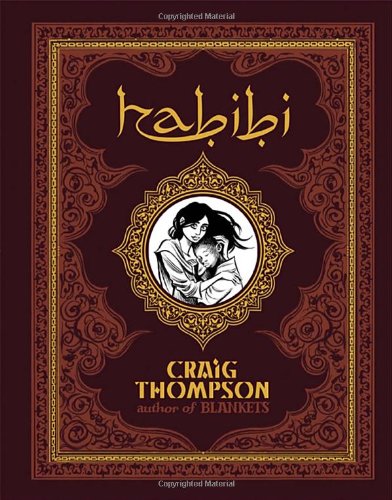
Habibi by Craig Thompson

Two children, Dodola and Zam, escaped from slavery and live alone for years in the desert.  As they grow older, their relationship becomes strain as Dodola sees Zam as her child and Zam begins to experience sexual attraction.  Dodola is captured and becomes a slave in the sultan's harem.  Zam goes in search for her.  Years pass, but the two never stop looking for each other.

Well.  So.  I heard lots of mixed things about this one.  Some were saying it was the most amazing thing ever.  Others disagreed and had major problems with it.

I also had problems with it.  But first things first.  It was beautiful.  Absolutely beautiful.  All of Craig Thompson's work is beautiful and I love his style of drawing and how gorgeous it can be in just black and white.  So Habibi was no exception.  Beautiful as always.

Related Posts Plugin for WordPress, Blogger...