Showing posts with label graphic novel. Show all posts

Thursday, April 23, 2015

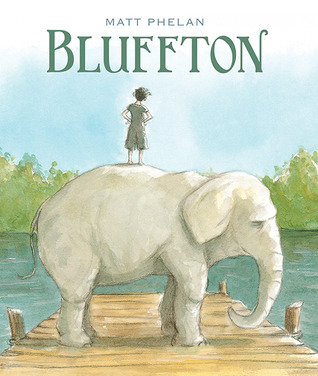
Bluffton: My Summer with Buster by Matt Phelan

It's 1908, and not much happens in Muskegon, Michigan.  But all that changes when a troupe of vaudeville performers come to summer not far from Muskegon.  Henry can't believe his eyes.  The elephants, zebras, and the kids who travel with their families!  What a life!  Henry befriends Buster, a kid his age who is part of his family's act.  Henry wants Buster to teach him all his tricks, but all Buster wants is to play baseball and pull some pranks.

Henry is a fictional character, but all the vaudeville people mentioned in the book are real, and they really did summer at Bluffton where Joe Keaton, Buster's father, founded The Actor's Colony.  Buster, of course, is Buster Keaton, famous comedian and film star.  Before he became that famous film star, we learn, he was part of a family act where he was "the human mop."  He got throw around, took lots of falls, and got right back up again.

Henry is jealous of Buster.  Henry thinks his life is boring.  Here he is in this nothing little town, where nothing every happens.  His father owns a store.  He helps his father in his store.  He goes to school.  That's his life.  But Buster!  Buster gets to travel the world!  He can do all sorts of tricks and falls.  He can juggle.  He meets all kind of interesting people.  He's personable and friendly.  Henry wants to be like him.

Buster, we the reader can see, does not think he's quite so lucky.  He wants to spend his summer, the only time he doesn't have to perform, playing baseball.  He doesn't want to teach Henry falls and tricks.  He doesn't want to do them when he doesn't have to.  We can tell Buster wishes he'd had more schooling.  Perhaps more of a "regular" life.  That maybe he doesn't want to be in vaudeville forever, but Henry can't see that.

There's a lovely moment in the book where Henry talks to his father about not wanting to be a store keeper.  His father tells him he never expected him to be.  He wants Henry to do whatever will make him happy.

The art is done in lovely pale water color.  It invokes a feeling of "another time."  There are many wordless panels where everything we need is in a look or gesture.  A beautiful book.  Might take some pushing to get kids to read it.  It might not be one they'll just pick up.  Sell it by talking about the elaborate pranks Henry and Buster pull on the school principal.

Tuesday, April 21, 2015

How to Fake a Moon Landing: Exposing the Myths of Science Denial by Darryl Cunningham

Darryl Cunningham debunks a number of prevalent myths, from the moon landing being a hoax to vaccinations causing Autism.  For each myth Cunningham uses science and proven facts to explain why the myths are just that: myths.

I found this to be a very informative book, but it's also a book that's preaching to the choir.  You're not going to pick up this book if you're a person who thinks climate change doesn't exist or that there's no such thing as evolution.  This isn't going to be the book that manages to convince naysayers otherwise, because the naysayers aren't going to pick up a book on exposing the myths of science denial, even if it's in a friendly graphic novel format.

But if you're a person who's interested in where these myths come from, and how they can scientifically be refuted (so you can impress your friends and be prepared for your next cocktail party when someone says, "So what do you think about fracking?") this is the book for you.

What I liked about it was that it stressed critical thinking and the scientific method.  Cunningham was very clear that just because we find something to be true now using the scientific method, doesn't mean that that will always be the case.  Some new piece of information or research might come along that changes things.  Something new might be discovered.  But we must think critically and base our understanding on facts that come about through careful experimentation and observation.  We can't disregard pieces of information because they don't fit with what we personally think, or what we'd like to be true.

Cunningham provided evidence for each issue he was looking at, as well as explaining how the myth originated, and how scientific data and facts can prove the myth inaccurate.

The writing is clear and straightforward, although I found some concepts easier to understand than others.  I still find the concept of fracking confusing.  Also, frack will never not make me think of Battlestar Galactica (the one with the moral dilemmas, not the one with the laser beams).

The book is arranged in strips, with three rows on each page with two panels per row with little variation.  The art is carrtoonish, and is mixed with real photographs and detailed portraits of individuals mentioned.  It made for an interesting mix.

While younger middle school students might have difficult, I think this would be appropriate for 8th grade and up.

Tuesday, February 24, 2015

Jane, the Fox & Me by Fanny Britt, illustrated by Isabelle Arsenault

Helene used to be friends with a group of girls at schools.  But now they all make fun of her, calling her fat.  Helene has no one now.  She finds comfort in reading Jane Eyre.  Jane had no on either, but she was still smart and capable.  The final straw comes when Helene is humiliated in front of everyone on a school trip.  Not even Jane Eyre is enough anymore.

This was lovely.  A heartfelt story about bullying, the feeling of isolation, and the impact a single person can make by reaching out to another.

Helene takes things especially hard because the girls who are now tormenting her were once her friends.  Helene doesn't really know what happened, but now she has no one.  No one will talk to her.  She is a social outcast.  Helene works her way through Jane Eyre, finding a companion in isolation and comfort that things can work out OK, even for someone who is friendless.  Helene begins to despair when things take a bad turn for Jane, and she has to go on a retreat with her whole class.

It's on this retreat that Helene, feeling more alone than ever, sees the fox.  The fox is beautiful and approaches her.  But even this magical moment is ruined and makes her feel like a freak.

I was confused throughout the book by how Helene was draw.  All her ex-friends are calling her fat.  She's sure her mother is ashamed of her.  But she didn't look overweight at all.  It all becomes clear toward the end when Helene goes for her yearly physical and her doctor informs her she's right on track.  Helene insists she's fat.  The doctor informs her she isn't anything of the kind.  The kids at school calling her fat got into her head until Helene truly believed that she was.  And the kids calling her fat were just being cruel.  It was based on nothing.

The illustrations were for the most part in gray and black, reflecting Helene's depression and feelings of isolation.  The only color was when we saw Jane Eyre.  Jane's life had a little color in it, although Jane herself was still all black and white.  For Helene, everything is gray until the fox appears.  The fox is bright with color.  A fleeting brightness in Helene's life.  But then it's gone and everything is black again.

As Helene makes friends with Geraldine, color begins to come into Helene's world.  Not right away.  But after making a friend and realizing she isn't actually overweight, we begin to see a few spots of color.  On sneakers and tee shirts, in the trees, and it ends with Helene walking into a world of color.

Wednesday, August 20, 2014

Amulet: Escape from Lucien by Kazu Kibuishi

The sixth book in Kazu Kibuishi's Amulet series finds Navin and Alyson stranded in Lucien, a supposedly abandoned city, in a search for a beacon that must be activated.  Meanwhile, Emily, Vigo and Trellis head back into the Void with Max, where they confront the Voice itself.

Such an exciting volume!  Some really crucial and dramatic stuff happens!  I can't tell you what because it would totally ruin it! 

You definitely need to start from the beginning with this series.  I skipped a couple and I know I'm missing things.  I need to go back and read them all straight through.  It's definitely a series worth reading.

The development of the characters continues to build in each book.  We learn more and more about them, what motivates them, how far they are willing to go for their desires or their friends.

We meet some new characters that clearly are going to become a bigger part of the upcoming story, and some old characters we haven't seen in a bit are brought back in.

The art is beautiful as always.  Since I had an ARC, most of the book was black and white, but the first section was in the full color.  There are beautiful double paged spreads, close ups on characters to show emotion and the images always enhance, not just support the story.


I wish I could say more, but I'm hesitant because I want everyone to go and read this series and enjoy it!  Highly recommended.

Escape from Lucien comes out August 26, 2014.

Tuesday, July 15, 2014

Sisters by Raina Telgemeier

Raina Telgemeier returns in this companion to Smile.  Raina always wanted a sister, but Amara isn't the fun friend to play with Raina had in mind!  Amara is grouchy and likes to keep to herself.  Their relationship only becomes more strained as they get older.  It all comes to a head when they're trapped on a family car trip from San Francisco to Colorado.

As with all of Raina Telgemeier's books, this was cute and sweet and thoughtful.  I didn't enjoy it quite as much as Smile or Drama, perhaps I had unrealistically high expectations.  I just didn't feel like there was a much to this one as there was to the others.  And the ending felt unfinished and sudden.  I still loved reading it, and fans of Raina's will be delighted with this.

Raina's siblings don't come into Smile very much.  Smile is mostly focused on Raina's relationships with her friends.  In Sisters, we get to see the family dynamics.  The book goes back and forth between the present day with Raina, Amara, their little brother and their mother setting off on the road trip, and when Raina and Amara were little.  We get to see Raina as a toddler wishing for a sister, and her disappointment that Amara didn't turn out to be the sister she was hoping for.  We see Amara's personality beginning to develop, which is a demanding, independent, and rather grouchy one.  Both sisters have a love for drawing, but it doesn't seem to be something they can share and do together.

The family is going to visit Raina's mother's sister, who they haven't seen in years, and Raina will get to spend time with her cousins.  She's very anxious about fitting in and making sure they like her.  Amara doesn't care.  Raina has learned to tune out problems at home, which include her parent's constant fighting, Amara's tantrums, and her little brother's general noise, by listening to music.  Music is clearly an important part of her life, but she comes to realize that she's missing out on a lot by plugging herself in.

As the family returns home, Raina's mother tells the siblings that she and their father need some time apart.  Raina is surprised, but Amara isn't.  The book ends with the hope that the sisters will begin to support each other more.

The ARC I had wasn't in full color yet, but the pages that were in color had a slightly darker color pallet.  More greens and browns and yellows than her others, I think.  As with her other graphic novels, the story is told through standard panels with Raina's adorable and friendly looking characters.

Sisters comes out August 26, 2014.

Sunday, June 22, 2014

This One Summer by Mariko Tamaki and Jillian Tamaki

Rose and her parents have been going to Awago Beach since Rose was five.  Rose loves it there, and loves seeing her summer friend, Windy.  This summer, however, things are not the same.  Rose's mother is acting odd, and her parent's keep fighting.  Rose and Windy find themselves witnessing the drama of the local teenagers and taking sides.  Everything seems the same but different.

Beautiful coming of age story.  There's so much that's left unsaid, that doesn't need to be said because of the power of the illustrations.

I don't think it's ever explicitly said how old Rose is.  My guess is 12, maybe?  She's in that in-between stage.  She isn't a teenager, not in high school yet.  She's too old to think of herself as a kid anymore.  She's getting crushes on boys, thinking about getting breasts and her period.  Her best summer friend, Windy, is about a year younger than she is.

It's unclear for most of the story what's going on with Rose's mother.  Is she sick?  She does appear to be very thin and drawn.  She portrayed coughing a few times.  But we come to understand that Rose doesn't know what's going on with her mother either.  Just that she very withdrawn, often short-tempered, doesn't seem to have to patience for things they've always done.

Rose is close with her father.  He laughs and jokes and teases her.  She feels abandoned when he leaves to go back to the city in the middle of their summer.  Now Rose feels she's completely on her own, trapped with her mother who isn't acting like her mother.

Windy's relationship with her mother is a sharp contrast to how Rose feels about her own mother.  Windy's mother seems open and passionate and outwardly shows her love for her child.  All the things Rose feels like are missing right now.  Although it's never said, Rose also feels some resentment toward her mother for wanting to have another child.  Why doesn't her mother feel like she is enough, like Windy's does?

Rose finds herself witness to the drama of the older teenagers of Awago Beach.  Rose has a crush on Doug, who works at the town store.  His girlfriend, Jenny, gets pregnant.  Doug won't talk to Jenny or call her.  Rose immediately falls into defending Doug in her head.  What if Jenny's lying?  What if it's not Doug's?  What if Jenny is cheating on him?  That Jenny is a slut.  Rose has no base for any of this thinking, really.  She has none of that "girls should stick together" mentality.  She just wants the boy she likes to be a nice, good guy.

There's a theme of children and childbirth.  Wanting babies, not wanting babies.  Being too old to have one, being too young to have one.  It gave the story a life-cycle feel.  Beginnings and endings.  Summer beginning, summer ending.  Growing up, getting older.

The art if just beautiful.  It's black and white, but the blacks have shades of blue and gray.  The quietness and peace of the summer that Rose so loves is reflected.  Through uses of close-ups and wordless panels, we get a clear understanding what the characters are thinking and feeling.

Quiet, beautiful, powerful story.  Highly recommended.  

Tuesday, June 3, 2014

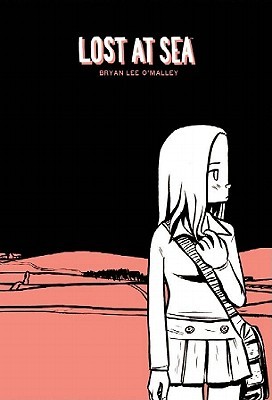
Lost at Sea by Bryan Lee O'Malley

Raleigh is fairly sure she doesn't have a soul.  She's also fairly sure a cat stole it.  She hates cats, but they always seem to be around her.  She's not good at interacting with people.  She doesn't seem to feel what other people feel.  And everything's always just so horribly confusing and mixed up all the time.  And now she's in a car with three classmates who she hardly even knows on a never ending road trip, and isn't even sure how she got there.

Raleigh's story slowly unfolds.  She's in a car with three other kids she doesn't seem to know super well.  It's unclear we're they're going to or heading from all how they all ended up in the same car.  Raleigh is very much trapped in her own head.  Her thoughts swirl in turmoil and confusion.  She's not good at interacting with people, or reading people.

In bits a pieces Raleigh reveals her background that got her to where she is now.  At the same time, the four teens are trying to get back home, dealing with car issues and trying to find hotels.  Raleigh starts to warm toward the others, although she's hesitant about opening up to people.

The whole "my soul was stolen by cats" thing was weird.  But her new friends take it in stride when she finally tells them this and they gamely sneak out cats to see if they can find Raleigh's soul.

The drawings are black and white and lack detail.  For the most part it was presented in traditional comic book frames with a few full paged spreads.  The darkness of the drawings and the lack of detail fit perfectly with Raleigh's confused and worried mind.

I found the ending a little unsatisfying.  It just ended after the big reveal.  There wasn't much more to conclude things.  We don't really know what happens.  I think it captures a teenager's angst and confusion well.

A little spoilery

Monday, June 2, 2014

The Undertaking of Lily Chen by Danica Novgorodoff

Are the accidental death of Deshi Li's brother, Deshi sets out to find a bride that will keep him company in the afterlife.  When a woman's body is hard to find, Deshi turns to more desperate means find one.

Deshi Li is the younger son, and clearly his older brother was the favored one.  His parent doted on him.  As the book progresses, we learn about the older son and how he was not quite as perfect as his parents thought.  Deshi struggles with his guilt over the part he played in his brother's death, which he does not tell his parents about.  Deshi Li does not believe in the custom of burying unmarried men with a woman to keep them company, but he is determined to do this for his brother and to give his parents a reason to take pride and comfort in him.

Deshi is a scared and timid character.  We really learn very little about him, even over the entire course of the story.  It's not clear what motivates him, aside from fear of his parent's and guilt about his brother.  What does he want?  What does he hope for?  I have no idea.  We learn much more about Lily.

Tuesday, January 28, 2014

Bad Houses by Sara Ryan, illustrated by Carla Speed McNeil

Lewis' works with his mother, Cate, running estate sales; sorting through dead people's belongings and getting them ready to sell.  Anne lives with her mother, Danica, and a house stuffed full of all the things Danica is unable to part with.  Lewis and Anne get to know each other after meeting at an estate sale.  Anne is trying to understand why people keep things and leave things, and what makes something important.

Such an interesting story.  I liked the juxtaposition of Lewis and his mother running the estate sales, and Anne and her mother, who live in such disorder.  One family whose job it is to clean up and arrange and get rid of things, and another incapable of getting rid of things.

I found myself strongly empathizing with both Anne and Lewis, but Anne is particular.  Maybe because I like to keep thing pretty neat and clean.  I felt her shock, horror and betrayal when she found her mother and filled her room with junk in order to clear out the living room so she could invite her new boyfriend over.  Anne's room was her one safe space, where there was no clutter or mess.  Now her safe haven had been infiltrated and there wasn't any place left for her.

I was frustrated at both Lewis and Anne's parents for their selfishness, even though I knew that there was a lot more going on than selfishness.  I wanted to shake them and say, "Can't you see what this is doing to your kid?  Don't you care?!"  Of course they cared, but they had their own issues to deal with as well.

We have two stories going on.  We have the story of Lewis and Anne, who meet and start dating and fall in love, and struggle with their own personal problems, and we have the story of Cate and Danica, or in particular, their back story, and how what happened in the past is effecting what is happening to Lewis and Anne today.

Spoilers

Friday, January 24, 2014

Bandette: Presto! by Paul Tobin, art by Colleen Coover

Bandette is the greatest thief in France.  She's also a teenager.  Other criminals despise her, and Police Inspector Belgique can't stand her, but will still call on her for help.  When a rival thief warns Bandette about a dangerous criminal group determined to get rid of her, Bandette laughs it off.  But will she be able to survive the evil Finis?

Bandette is kind of a Robin Hood figure, but not quite as selfless.  Yes, she does rob bad guys and resteal stolen items, but she's also totally OK with snatching things she likes and keeping them for herself.  She helps the police when it suits her.  She has a band of "street urchins" she calls on for help.  It is unclear if any of them actually live on the street.  I don't think so.  I think it's just a pet name.

I didn't love.  It was cute and all.  Fast paced.  I thought the level the book was written at was a little odd.  I had thought this was a middle grade book.  It had that appearance, and the language was fairly simplistic, as was the story.  But then we had pictures of people in their underwear in sexual situations and some profanity which took it out of the middle grade range and put it into YA.  I just wasn't grabbed by the story in any way, or cared very much about any of the characters.

Bandette is very caviler about the danger to her, which is fine, I guess, but she also seems totally fine with putting all her friends in danger as well!  Less cool.  We really didn't learn anything about Bandette.  We just know she's a flirty thief.  I guess I didn't really care very much about her or worry that she might possible in danger because she clearly didn't care, and I didn't have anything to care about.

Not sure who I would recommend this too.  It really does seem too young for YA, but not quite middle grade either.

I liked the art, it was cute, but again, it just had a middle school look to it.  It reminded me a bit of Raina Telgemeier, if Raina Telgemeier drew an action comic.

Thursday, January 16, 2014

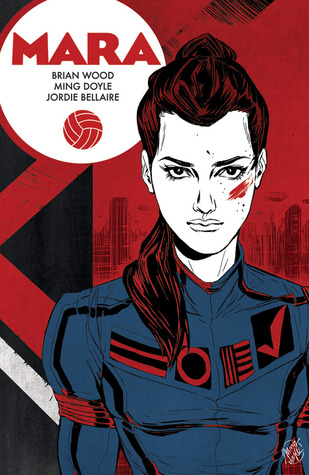
Mara by Brian Wood, illustrated by Ming Doyle

We're in a world that holds soldiers and athletes in the highest esteem.  Mara is the best of them all, an incredibly talented volleyball player, she is known the world over.  Everyone loves her, no matter what side of the war they are fighting on.  When Mara begins showing signs of superpowers, her fans turn on her.  Now Mara isn't sure the world has a place for her any more.

Lots of spoilers.

This collects Mara #1-6.  I didn't love it.  I was kind of interested in the world, except there wasn't enough information to understand the world very well.  It seems to be a world that's constantly at war but we don't know why.  We don't know who's fighting who.  There are special schools to groom athletes.  Everyone is expected to do their duty to the country.  But why?  And how does it all work?  No hints.

Mara is the perfect specimen.  Physically, intellectually.  She is perfect.  She would be a perfect solider or athlete.  Everyone loves her.

Mara essentially turns into superman.  She can do everything.  She can fly.  She can move things with her mind.  Bullets cannot harm her.  She seems to know no weakness, which isn't very interesting.  While she's been groomed for a secrete branch of the military, her brother is captured (by her own country) and tortured to see if he will manifest superpowers too.  Mara goes rogue and easily breaks out of the training facility.  When she discovers her brother has been tortured to death, Mara is done with humanity.

I'm not really sure where it's going.  Mara has rejected the human race and now she's floating around in space.  So what's next for her?  There weren't really any clues.  And is this series continuing?  Or was that the end?  If that was the end, it was a pretty weak ending.

Tuesday, January 14, 2014

The War Within These Walls by Aline Sax, illustrated by Caryl Strzelecki

A young boy and his family are forced into the Warsaw ghetto, along with all the Jews of Poland.  After years, the Nazis prepare to liquidate the ghetto, and some of the Jews prepare to fight back.

It's not a graphic novel, exactly.  Although I think I'd shelve it with graphic novels, because I think that's where someone would look for it.  It's more an illustrated novels.  It's a beautifully put together book.  The words and illustrations are kept separate.  I found this allowed me to focus deeply on both words and images without getting distracted by one or the others.  Sometimes words appeared on black pages, all alone.  Sometimes the text was very short, other times it would be a whole page.

The illustrations were powerful.  They were done in black and white and were made up of hundreds of individual line strokes.  The illustrations were so full of emotion.  You could feel the pain and despair, the hopelessness and darkness these people were feeling.

In the story we follow the young boy and his family, first as the Nazis move into Poland and restrictions are put on Jews, and then to the entire Jewish population being moved into the ghetto.  The ghetto was so crowded, and there was so little food coming in, everyone was slowing starving to death, or being wiped out by disease.  People actually volunteered to get on the Nazi trucks (which took them to concentration camps) in the hopes they were being taken somewhere better.

The boy uses the sewers to sneak out of the ghetto and bring food to his family, until the Nazis begin using flame throwers to kill the smugglers in the sewers.  Then he is afraid to do anything, until he meets Mordechai Anielewicz, who is organizing Jews to fight back.  They know they cannot win, but they decided they will not quietly submit to death any longer.

Very powerful and beautifully done.

Saturday, December 21, 2013

Battling Boy by Paul Pope

Arcopolis is overrun with monsters of all kinds.  Only Haggard West can stand against them.  Too bad Haggard West has just been killed.  Meanwhile, in another galaxy, a 12 year-old boy on the eve of his 13th birthday is being sent out on his Ramble.  His father, a great hero and monster fighter, sends him to Arcopolis to save it.  Battling Boy has his work cut out for him.  And he might not be able to do it alone.

This was a good start to a series.  Several main characters are introduced, including Battling Boy himself, and Haggard West's daughter, Aurora, who was quite surprised to see another superhero show up on her turf.  We get a general idea of the world, but no specifics.  We don't know where the monsters are coming from, and we don't really understand where Battling Boy comes from, or who his people are.  Why do they send their 13 year-olds on life-threatening quests?  Do they all have superpowers?  Do they all get sent out to try and save other planets?

I am confused about Battling Boy's powers.  I hope it will become clearer with time.  His father seems to be a very power being called a Warlord.  He can shoot lighting from his fingers and has a number of other powers as well.  Battling Boy seems to mainly get his power through the 12 t-shirts he's been given.  Each has a different animal totem, and when he puts them on he gets some of that animal's strength.  What I'm not sure about is if Battling Boy has any powers just on his own.  It seems like he should.  But it's not clear.  Perhaps he's supposed to have powers, but doesn't.

Battling Boy gets himself into trouble pretty much as soon as he gets there.  He struggles against the first monster he goes up against, and calls his father for help.  His father, in the middle of fighting his own monster, doesn't have time to talk Battling Boy through the whole thing, and zaps the monster with his lightning powers.  Of course, the people of the city think it was Battling Boy who has lightning power, and he doesn't correct them.

The end of the first book leaves us with Battling Boy admitting that he doesn't have lightning powers, and is going to need Aurora's help.  The monsters of the city are teaming up to kill Battling Boy, and probably Aurora as well.

Art is in a traditional superhero style, with lots of action and fight scenes.  I found that other than the main characters, everyone else kind of looked alike, especially the members of the military.  Perhaps that was intentional?  Or maybe not.

Tuesday, December 10, 2013

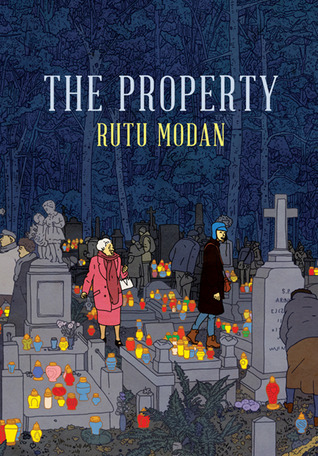
The Property by Rutu Modan

After the death of her father, Mica and her paternal grandmother Regina Segal travel to Warsaw in an attempt to claim property lost during WWII.  Regina has not been back to Poland since she was sent away to Israel before WWII.  But Regina is carrying a secret.  She has other reasons for coming to Warsaw.

Rutu Modan is the author of Exit Wounds, which is on my "to read" list and had a lot of positive buzz when it came out.  There's been lots of buzz about The Property too, and it's started showing up on "best of 2013" lists.

We have two parallel stories happening, Mica's and Regina's.  Mica doesn't know what her grandmother's actual purpose in Warsaw is.  All she knows is that her grandmother initially wanted to come to Warsaw to claim this property, but upon arrival she wants nothing to do with it.  Mica sets out to find the property herself.  She has to deal with a snoopy and interfering friend of her aunt's (who has plans of his own) and meets a young Polish man.  All while trying to figure out what on earth is going on with her grandmother.

Spoilers

Tuesday, December 3, 2013

Relish: My Life in the Kitchen by Lucy Knisley

Lucy Knisley's most vivid memories are of how things tasted.  She grew up with a foodie father and caterer mother in the middle of New York's blossoming food scene.  Her memoir tells the love story of her relationship to food, and provides many tasty recipes along the way.

Lucy tells vignettes of her life which all revolve around food in some way.  She recalls her quest for the perfect chocolate chip cookies; her trip to Mexico with her mother and her friend Drew's family (their moms got the flu and the two of them ran all over San Miguel eating cheap food); working in a cheese shop like her mother; relating to her father through food.

As well as giving us a picture of her life, Lucy gives us some of her recipes.  Of course, they are told through image and words, it's a comic, after all!  Her recipes include huevos rancheros, veggie sushi (I feel like I could actually make sushi now!), and shepard pie, among others.

At first I thought the art looked much different than it did in French Milk.  Then I realized, no, it's not the art that looks so different, it's the colors.  The style is the same, but French Milk was in black and white, so the lines were much more clear and detailed.  Relish is done in bold, almost muddy colors (I didn't love the color palette), causing the illustrations to appear less detailed.  I still like the style, which is very cute.

Relish is great, because it not only tells the story of the love of food, but also the story of an awkward kid growing up and making mistakes.  Great for young adults and adults alike.

Friday, October 11, 2013

The Silversix by AJ Lieberman & Daren Rawings

Phoebe has been living on her own since her parents died a year ago.  When a strange man comes looking for her, Phoebe runs for it, taking with her the moon registry her parent's left her.  Phoebe gets nabbed by Child Welfare Services and finds herself living in a home for orphaned children.  She meets five other kids, all who have the same moon registry, all signed by Phoebe's father, all whose parent's died on the same shuttle explosion.  The Silversix set out to find the truth of their parent's deaths, and maybe bring down the most powerful company on Earth.

It was fun, but a lacking in details.  Some kids won't care.  But there wasn't a whole lot of world building. Craven Mining controls pretty much everything, because they control the Hydro-2, some kind of energy source.  But I wasn't totally sure what, exactly, Hydro-2 was, how it was mined, why there were steel bubble, and why there couldn't be any open space.  So I had a lot of questions.  Oh, I was also confused about what the transmission that was sent to Phoebe's location before the shuttle blew up.  What was the transmission?  It wasn't the moon registry, all the kids already had those.  So...what exactly was it that they were looking far? Whatever

So yes, there were holes.  A fair number of holes.  But despite that, it was still an enjoyable read.  Phoebe is spunky, determined and resourceful.  The friends she makes are a rainbow of ethnicities, and they create for themselves their own kind of family.  All does not go smoothly.  The kids get to use their various talents to get themselves out of trouble.

The ending also happened rather quickly, and was again lacking in detail.  Suddenly they're all heroes and Craven is in jail and no more Hydro-2 and all the open space comes back.  Hmm, the more I write about this the more I realize that there was a lot missing from this story.

The art was cute and cartoony.  I didn't like the color pallet so much, I thought it looked a little sickly, that maybe that was intentional to create a feel for the world.  The format was traditional comic panels with very little breaking out of the mold.

Tuesday, October 1, 2013

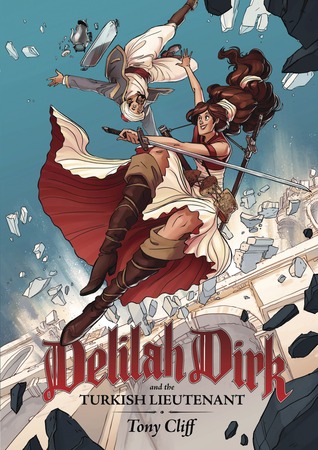
Delilah Dirk and the Turkish Lieutenant by Tony Cliff

Erdemoglu Selim is a lieutenant in the Turkish Janissary Corps, and he doesn't love it.  What he really wants is to live a quiet life and make tea.  That becomes impossible when Delilah Dirk, a swashbuckling adventurer, is imprisoned, and then escapes the Turkish palace.  Selim is swept up and along with Delilah Dirk, and soon he must decide if this life of adventure is really for him.

Oh First Second.  Do you ever get it wrong?  So much fun!  I love how Delilah Dirk is totally unapologetically herself.  She makes no excuses, and has little patience for waffling. 

The only disappointment was that this was billed as Delilah Dirk's story.  I mean, it is called Delilah Dirk and the Turkish Lieutenant.  But it was really the Turkish Lieutenant's story.  It was from Selim's point of view and was his story of his meeting and joining Delilah Dirk.  That didn't stop it from being a fun graphic novel.  I liked how Selim and Delilah Dirk worked together and played off each other. Although she ended up being a secondary character in her own book, Delilah Dirk is certainly not in the background!  I wonder if all the books will be from Selim's point of view.  I hope more of the stories will get to revolve around the title character.

After Delilah Dirk rescues Selim from being beheaded because he's suspected to be in league with Dirk herself, their first adventure is stealing treasure from the Evil Pirate Captain Zakul.  Selim is skeptical, but goes along with it, and soon they're blowing up bridges and running from pirates and escaping in flying boats.

Her outfit is kind of odd, don't you think?  When Selim is first interrogating Delilah Dirk he says, "Why do you dress like this?  Certainly you would look more at home on the street corner."  Delilah Dirk is about to give him a snappy reply, when she's distracted with how delicious the tea is.  And we never get back it.  Why does she dress like that?  She's always in motion.  Sword fighting, jumping out windows, making speedy getaways.  I'm trying to decide if her outfit doesn't make sense for her character, or actually dressing in this way does make sense, because she's Delilah Dirk and she's going to wear whatever she damn well pleases.  Unclear.

While I don't think this would be above middle schooler's heads or anything, the content does deal with battles and stabbing people with swords.  A lot of people die at Delilah's Dirk's hands.  So just a heads up.

The art appears to be digitally created (I think) but I found it very pretty and the colors are nice and bright.  It has a mostly traditional comic book layout, although there were some lovely full page spreads and great action scenes that broke out of the panels.

Sunday, August 11, 2013

Primates: The Fearless Science of Jane Goodall, Dian Fossey, and Birute Galdikas by Jim Ottaviani and Maris Wicks

The true stories of three scientists who changed the way we think about primates forever.  Jane Goodall, Dian Fossey and Birute Galdikas were all recruited by anthropologist Louis Leakey and set out, with little to no training or background, on field research that would result in discoveries that advanced our understanding of the link between humans and primates.

Another triumph from First Second!  Seriously, can they do anything wrong?  I don't think I've read anything from First Second that I haven't loved.

This is a great middle grade graphic novel that does an excellent job at showing how each of the three women got her big break, the research she did, discoveries made, and also the toll this kind of work took on her personal life.

Jane Goodall was the first to be discovered by Louis Leakey.  Jane had always wanted to study animals, but for a while her work had nothing to do with animals.  She jumped at the chance to visit a school friend in Kenya, and there she met Louis Leaky, who was working in Nairobi.  She started out working as Leakey's secretary, but soon had the chance to study chimpanzees.  So off she went, with no schooling in anthropology or sciences, no advanced degree.  She named the chimpanzees, much to other scientist's disgust (scientists usually would number them), but when Jane observed chimps using tools and eating meat, she earned the respect of her peers.

Friday, August 9, 2013

Draupadi: The Fire-Born Princess by Sarawati Nagpal, art by Manu

 Princess Draupadi rises from a sacred fire after her father's prayers.  She is to be married to her love, Arjuna, a Pandava prince.  But Draupadi's destiny surprises even her, as she finds she must marry Arjuna's four brothers as well.  Her husband's cousins, the Kauravas do everything in their power to hurt her family and bring down the Pandavas.  Draupadi discoveries her purpose is to bring about the end of the Kauravas.

I didn't love it.  I appreciated the telling of a myth that we don't often get to hear.  Greek myths get told over and over again in a variety of forms, but this is adapted from the Indian epic Mahabharata, a story many people have never heard of.  I really wanted to like it.

Draupadi herself is an interesting character.  She born full grown for the purpose of marriage, but her destiny is larger than that.  She deals with going from marrying the man she loves to having to marry his four brothers as well.  She is hotheaded and outspoken.  She demands revenge against those who have wronged her.  She grows as a person over the years and learns compassion.

Unfortunately, the storytelling and set up of the graphic novel did not do the story justice.  It just wasn't a very good graphic novel.  Rather than using the art to enhance the story, all the images did was reflect the text.  The art was flat pencil drawings.  Characters didn't look the same from panel to panel, making characters, especially the men, hard to follow.  Most problematic were the large blocks of text on each panel.  What is the point of a graphic novel when most of the text is still narrative?  You have the medium that allows people to see what's happening.  It seemed like we had a prose story that was cut up into small chunks and glued onto pictures.  It was essentially a long picture book, not a graphic novel.

So it was disappointing all around - the art, the text, the poor use of the medium.  It made reading it a slog and completely took away from what could have been a really interesting story.  I would have liked to have seen it in someone else's hands.

Sunday, August 4, 2013

Blue Bloods The Graphic Novel by Melisa De La Cruz, adapted by Robert Venditti, art by Alina Urusov

The Blue Bloods vowed that their immortal status would remain a closely guarded secret. And they kept that secret for centuries. But now, in New York City, the secret is seeping out. Schuyler Van Alen is a sophomore at a prestigious private school. She prefers baggy, vintage clothes instead of the Prada and pearls worn by her classmates, and she lives with her reclusive grandmother in a dilapidated mansion. Schuyler is a loner...and happy that way. Suddenly, when she turns fifteen, there is a visible mosaic of blue veins on her arm. She starts to crave raw food and she is having flashbacks to ancient times. Then a popular girl from her school is found dead... drained of all her blood. Schuyler doesn't know what to think, but she wants to find out the secrets the Blue Bloods are keeping. But is she herself in danger? (from Goodreads)

As the title makes clear, this is the graphic novel adaptation of the popular Blue Bloods series.  I have not read the original book (it wasn't one of the vampire series I got too) so I can't really comment on the adaptation, unfortunately.  The story seemed to move along well, and it certainly was pretty to look at.

Schuyler is out main character and our outsider who just doesn't fit in in her exclusive and well-off high school.  Sky's mother is in a coma and she lives with her aunt.  When she learns she's a Blue Blood, her whole life is turned upside down and she's desperate to find answers.  Her love interest is Jack Force, the most popular boy in school and sister to the most popular girl in school, Mimi.  Jack and Sky, of course, feel some kind of deep connection to each other neither of them understands.

So, you know, nothing new.  It's a supernatural romance.  But it's certainly entertaining, and the art is beautiful.  Everyone in it is gorgeous - tall and thin and beautiful, men and woman.  It was a fast read, and takes you through the first book in the series. 
Related Posts Plugin for WordPress, Blogger...