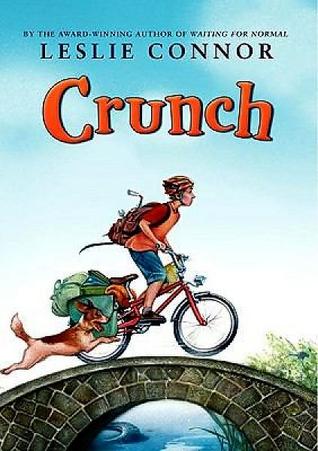
Dewey Mariss and his siblings are in the middle of a crunch. There's no gas anywhere, and their parents are stuck up north. It's up to the Mariss kids to keep things running at home, and it's up to Dewey to manage the family bicycle-repair business, which is booming! Can Dewey handle all the bikes? And what should he do when bike parts start to go missing?
I loved this. Loved loved loved. Let me count the ways. First off, the setting was really interesting. Just looking at the cover and reading the description didn't immediately make me think about a dystopian setting sometime in the future. And the fact that we're sometime in the clearly near future and gas has run out was what set the story in motion, but it wasn't about the dystopia itself. Like, you know, Hunger Games, and all those. That was just the time we're in. We don't get a lot of information about the world. It's mentioned there have been gas shortages before. And that maybe gas running out entirely will cause electric cars to come back. The police have a couple electric powered pods. But otherwise, we're just in a regular old world where something just slightly futuristic and dystopic is happening. Usually I want lots of world building, but this felt just right for the kind of book it was.
The story itself was not about the world, but about Dewey and his family and how they try to handle things while their parents are gone. The parents are absent for a completely logical reason - their father is a truck driver, and for their parent's anniversary their mother went on a trip with him. Then the gas ran out and now they're stuck far away. The parent's don't just disappear. They call home every night to check on their children and see how they're coping and do what they can to reassure them.
Showing posts with label dystopia. Show all posts
Thursday, May 29, 2014
Crunch by Leslie Connor
Labels:
boy appeal,
dystopia,
family,
fiction,
middle grade
Tuesday, March 25, 2014
The Coldest Girl in Coldtown by Holly Black
Tana and her ex-boyfriend Aidan are the only survivors of a massacre carried out at a party by vampires. Aidan is infected, and Tana might be infected too, it's too soon to say. Tana does the only thing she can think of - head for the nearest Coldtown, a quarantined location where vampires live and rule. Traveling with them is Gavriel, a very strange vampire who Tana saved and is now assisting them on their journey, and who is hiding a dark secret.
What made this book stand apart from other vampire books, aside from the obviously better writing and the well-rounded characters, was that The Coldest Girl in Coldtown shows vampires to be vicious and blood thirsty. They are, essentially, monsters, with no love or feelings for humans. Humans are there to be used as vampires wish.
The Coldtowns are well wired, and the lives of the vampires are the most popular reality TV to the outside world. Of course, you have people who dream of becoming vampires. Who think vampires are beautiful and sexy. Who think vampires are misunderstood. These people deliberately go to Coldtowns and try to get a vampire to turn them.
What made this book stand apart from other vampire books, aside from the obviously better writing and the well-rounded characters, was that The Coldest Girl in Coldtown shows vampires to be vicious and blood thirsty. They are, essentially, monsters, with no love or feelings for humans. Humans are there to be used as vampires wish.
The Coldtowns are well wired, and the lives of the vampires are the most popular reality TV to the outside world. Of course, you have people who dream of becoming vampires. Who think vampires are beautiful and sexy. Who think vampires are misunderstood. These people deliberately go to Coldtowns and try to get a vampire to turn them.
Labels:
dark,
dystopia,
fiction,
friendship,
romance,
supernatural,
vampires,
YA
Thursday, January 16, 2014
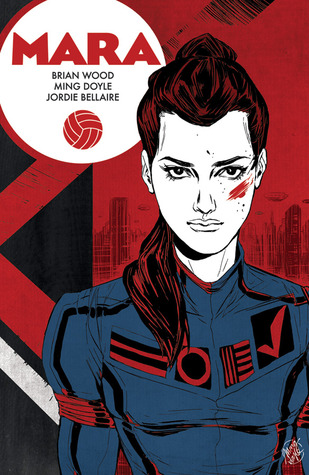
Mara by Brian Wood, illustrated by Ming Doyle
We're in a world that holds soldiers and athletes in the highest esteem. Mara is the best of them all, an incredibly talented volleyball player, she is known the world over. Everyone loves her, no matter what side of the war they are fighting on. When Mara begins showing signs of superpowers, her fans turn on her. Now Mara isn't sure the world has a place for her any more.
Lots of spoilers.
This collects Mara #1-6. I didn't love it. I was kind of interested in the world, except there wasn't enough information to understand the world very well. It seems to be a world that's constantly at war but we don't know why. We don't know who's fighting who. There are special schools to groom athletes. Everyone is expected to do their duty to the country. But why? And how does it all work? No hints.
Mara is the perfect specimen. Physically, intellectually. She is perfect. She would be a perfect solider or athlete. Everyone loves her.
Mara essentially turns into superman. She can do everything. She can fly. She can move things with her mind. Bullets cannot harm her. She seems to know no weakness, which isn't very interesting. While she's been groomed for a secrete branch of the military, her brother is captured (by her own country) and tortured to see if he will manifest superpowers too. Mara goes rogue and easily breaks out of the training facility. When she discovers her brother has been tortured to death, Mara is done with humanity.
I'm not really sure where it's going. Mara has rejected the human race and now she's floating around in space. So what's next for her? There weren't really any clues. And is this series continuing? Or was that the end? If that was the end, it was a pretty weak ending.
Lots of spoilers.
This collects Mara #1-6. I didn't love it. I was kind of interested in the world, except there wasn't enough information to understand the world very well. It seems to be a world that's constantly at war but we don't know why. We don't know who's fighting who. There are special schools to groom athletes. Everyone is expected to do their duty to the country. But why? And how does it all work? No hints.
Mara is the perfect specimen. Physically, intellectually. She is perfect. She would be a perfect solider or athlete. Everyone loves her.
Mara essentially turns into superman. She can do everything. She can fly. She can move things with her mind. Bullets cannot harm her. She seems to know no weakness, which isn't very interesting. While she's been groomed for a secrete branch of the military, her brother is captured (by her own country) and tortured to see if he will manifest superpowers too. Mara goes rogue and easily breaks out of the training facility. When she discovers her brother has been tortured to death, Mara is done with humanity.
I'm not really sure where it's going. Mara has rejected the human race and now she's floating around in space. So what's next for her? There weren't really any clues. And is this series continuing? Or was that the end? If that was the end, it was a pretty weak ending.
Tuesday, November 12, 2013
The Living by Matt de la Pena
Shy is spending the summer working on a cruise ship. It seems like a pretty great job, until, on his second trip out, he witnesses a man jump to his death. Now he's being followed and questioned, even though Shy knows nothing about the man. Then an enormous earthquake hits California, followed by a tsunami, destroying the ship.
This is the first book in a series. I hadn't read anything by Matt de la Pena before, even though Mexican Whiteboy has been on my "to read" list forever.
The Living mixes two dystopia/science fiction elements together: natural disaster and virus outbreak. Before the massive earthquake, we learn that Shy's grandmother and Carmen's (another cruise worker who Shy has a thing for) father both died of Romero disease, a new illness that's spreading over the Mexican border into California. It kills very quickly, if you aren't diagnosed right away. After the earthquake, which is huge, off the Richter scale, levels much of the West Coast, the disease runs rampant. And there's a TERRIBLE SECRET behind the disease, and it's linked to that man Shy saw jump from the ship.
Aside from the dystopian aspects of the book, which yeah, is the main focus, there's a lot in there about class differences. Shy is all too aware of the difference between him and the people who pay to be on the cruise. Are their lives worth more than his? It doesn't seem so, especially after the ship is gone, and Shy is on a lifeboat with a rich girl, Addie who wasn't all that friendly to him before and clearly looked down on him. But through their shared experience of suffering, they grow closer.
Shy and Addie end up on one of the Hidden Island that are contacted with the company the man who committed suicide worked for. Shy is reunited with the other ship survivors, only to discover the horrifying truth about Romero disease. Addie disappears, supposedly with her father, who works with this company, but I'm sure they'll be reunited in a later book. Shy feels like she betrayed him, even though he's sure Addie couldn't have known what was really going on.
It was a gripping story and I enjoyed it. A good pick for science fiction fans and fans of dystopia alike.
The Living comes out November 12, 2013.
This is the first book in a series. I hadn't read anything by Matt de la Pena before, even though Mexican Whiteboy has been on my "to read" list forever.
The Living mixes two dystopia/science fiction elements together: natural disaster and virus outbreak. Before the massive earthquake, we learn that Shy's grandmother and Carmen's (another cruise worker who Shy has a thing for) father both died of Romero disease, a new illness that's spreading over the Mexican border into California. It kills very quickly, if you aren't diagnosed right away. After the earthquake, which is huge, off the Richter scale, levels much of the West Coast, the disease runs rampant. And there's a TERRIBLE SECRET behind the disease, and it's linked to that man Shy saw jump from the ship.
Aside from the dystopian aspects of the book, which yeah, is the main focus, there's a lot in there about class differences. Shy is all too aware of the difference between him and the people who pay to be on the cruise. Are their lives worth more than his? It doesn't seem so, especially after the ship is gone, and Shy is on a lifeboat with a rich girl, Addie who wasn't all that friendly to him before and clearly looked down on him. But through their shared experience of suffering, they grow closer.
Shy and Addie end up on one of the Hidden Island that are contacted with the company the man who committed suicide worked for. Shy is reunited with the other ship survivors, only to discover the horrifying truth about Romero disease. Addie disappears, supposedly with her father, who works with this company, but I'm sure they'll be reunited in a later book. Shy feels like she betrayed him, even though he's sure Addie couldn't have known what was really going on.
It was a gripping story and I enjoyed it. A good pick for science fiction fans and fans of dystopia alike.
The Living comes out November 12, 2013.
Labels:
boy appeal,
dystopia,
fiction,
romance,
science fiction,
series,
YA
Monday, August 26, 2013
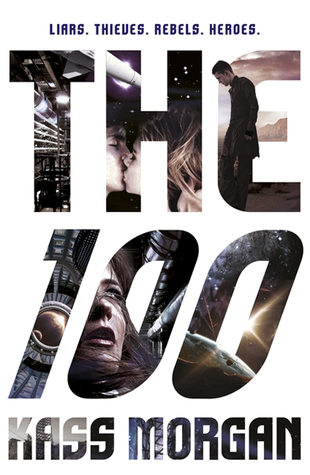
The 100 by Kass Morgan
The only humans left live in a space station orbiting above an Earth destroyed by radiation. But the space station can only last so long, so its leaders decide on a way to see if Earth is once again safe for human life. 100 juvenile prisoners are sent to Earth. If they survive, the rest of the human race can follow if they die...they were slated to be executed anyway.
The 100, which hasn't even come out yet, is already in development to be a show on the CW. It wasn't written specifically for that purpose, but I can see why it got snapped up for a show. It reads like TV episodes. It revolves around a collection of characters, all who are hiding dark secrets and chapters, and book itself, ends on dramatic cliff hangers.
The story is split between what's happen on Earth which focuses on juvenile convicts Clark, her ex-boyfriend Wells, who got himself imprisoned so he could go with her and try to earn her forgiveness, and Bellamy, the young man who shot the Chancellor in order to be on the ship with his sister.
On the ship we see through the perspective of Glass, who was supposed to go to Earth but made a run for it in the confusion and made it back to her wealthy family, who were able to secure her a pardon.
Our main character's lives, through slow reveals, are all intertwined. What did Wells do that was so unforgivable? Why does Clarke blame him for her parent's execution? Why was Clarke herself prisoned? What did Wells do that speed up the process to send the ship to Earth? What did Glass do to get herself imprisoned? What is the terrible secret she cannot tell anyone? Lots of drama. On Earth, we have a love triangle with Clarke, Bellamy and Wells. Up in the space station, Glass is reunited with her lower-class love, only to fear he will learn what she's still hiding.
The world building was pretty good. A lot is still left unsaid, but it's pretty clear that was deliberate. Humans left Earth in the first stages of the "Cataclysm" but there has been no detail so far as to what exactly that was. It's mentioned that some "infected" survivors made their way onto the ship and were quarantined. Anyone who gets sick on the ship is quarantined. The space station is split up into classes. Phoenix is where the wealthy live. They are the ruling class, they have the best food, better clothing options and more opportunities. Walden and Arcadia are where the lower class lives. Their lives are hard. They cannot come and go around the ship as they please. They are limited on food and clothing and job opportunities. Because of limited resources, there is a strict one child per family limit. Those that disobey are executed.
It's a pretty harsh world. Execution seems fairly typical. It doesn't seem that these people living in space have learned to adapt very well. They're just living off what meager resources they originally brought with them, and as those become less and less, Walden and Arcadia suffer more and Phoenix takes what there is.
I think teens who have enjoyed other dystopias will like this series a lot. Plenty of drama and romance for all.
The 100 comes out September 3, 2013.
The 100, which hasn't even come out yet, is already in development to be a show on the CW. It wasn't written specifically for that purpose, but I can see why it got snapped up for a show. It reads like TV episodes. It revolves around a collection of characters, all who are hiding dark secrets and chapters, and book itself, ends on dramatic cliff hangers.
The story is split between what's happen on Earth which focuses on juvenile convicts Clark, her ex-boyfriend Wells, who got himself imprisoned so he could go with her and try to earn her forgiveness, and Bellamy, the young man who shot the Chancellor in order to be on the ship with his sister.
On the ship we see through the perspective of Glass, who was supposed to go to Earth but made a run for it in the confusion and made it back to her wealthy family, who were able to secure her a pardon.
Our main character's lives, through slow reveals, are all intertwined. What did Wells do that was so unforgivable? Why does Clarke blame him for her parent's execution? Why was Clarke herself prisoned? What did Wells do that speed up the process to send the ship to Earth? What did Glass do to get herself imprisoned? What is the terrible secret she cannot tell anyone? Lots of drama. On Earth, we have a love triangle with Clarke, Bellamy and Wells. Up in the space station, Glass is reunited with her lower-class love, only to fear he will learn what she's still hiding.
The world building was pretty good. A lot is still left unsaid, but it's pretty clear that was deliberate. Humans left Earth in the first stages of the "Cataclysm" but there has been no detail so far as to what exactly that was. It's mentioned that some "infected" survivors made their way onto the ship and were quarantined. Anyone who gets sick on the ship is quarantined. The space station is split up into classes. Phoenix is where the wealthy live. They are the ruling class, they have the best food, better clothing options and more opportunities. Walden and Arcadia are where the lower class lives. Their lives are hard. They cannot come and go around the ship as they please. They are limited on food and clothing and job opportunities. Because of limited resources, there is a strict one child per family limit. Those that disobey are executed.
It's a pretty harsh world. Execution seems fairly typical. It doesn't seem that these people living in space have learned to adapt very well. They're just living off what meager resources they originally brought with them, and as those become less and less, Walden and Arcadia suffer more and Phoenix takes what there is.
I think teens who have enjoyed other dystopias will like this series a lot. Plenty of drama and romance for all.
The 100 comes out September 3, 2013.
Monday, July 15, 2013
Divergent by Veronica Roth
Everyone belongs to a faction - Abnegation (selflessness), Candor (honesty), Erudite (knowledge), Amity (peace), or Dauntless (courage). Tris has grown up in Abnegation, the faction dedicated to selfless actions, and the faction that is in charge of the government. But the Choosing Ceremony is approaching, and Tris has a chance to leave her faction, and family, for another. Tris knows that if she chooses Dauntless, her life will be forever changed. Not only will she never really be a part of her family again, but she will have to learn all the skills needed to make it through the physically and mentally challenging Dauntless initiation process.
Summaries of all YA dystopian books will from henceforth begin with "It was the future, and everything sucked." I finally got around to reading Divergent. It's been on my list forever, and the movie is coming out, and even though it's not like it's one I need to read in order to sell it to the children (it doesn't need my selling it) I wanted to read one of them. It was enjoyable. Nothing especially new under the sun, but enjoyable.
I was reading this on my way to Chicago, and since Divergent takes place in a future Chicago, that was kind of fun. I would read something and go, "I just went there!" And it was exciting. Also, I went to the dystopia panel where Veronica Roth spoke, and hearing her talk about what she was thinking when she wrote the book made reading it all the more interesting.
The book was engaging. Especially after hearing Veronica Roth speak, I really liked the idea of this community of people deciding to focus on the attributes that they felt were causing suffering in the world. Some people thought it was ignorance so they dedicated themselves to study. Some people thought it was violence, so they dedicated themselves to peace. It's all suppose to work together seamlessly, with each faction contributing what they excel in. But like so many good ideas, after a while things started to not quite work the way they were suppose to. And each faction essentially became what they had hated most. Those dedicated to selflessness become so focused on the needs of others they ignore the needs of their loved ones. Those dedicated to courage become so focused on showing others how brave they are they turn into bullies, which is form of cowardice.
Spoilers coming up if you haven't read it. You have, of course.
I liked the story. Tris was interesting, as was Four, the stoic love interest, and things were swinging all just great until we got to the great mind take over section. That was a little...weak. I don't know. There was a lot of build up. Why did they want to kill the people that were Divergent? What where the Erudites planning? How would they ever get all the Dauntless to fight for them? Oh. Mind control. Well, OK. I don't know. I was disappointed. I was expecting a big reveal and felt a little let down.
Also, kind of disappointed the main point of evil is coming from Erudite, the faction I totally would have chosen. Much like in Harry Potter, when most people wanted to be in Gryffindor and I wanted to be in Ravenclaw. I just want to go where the books are!
Summaries of all YA dystopian books will from henceforth begin with "It was the future, and everything sucked." I finally got around to reading Divergent. It's been on my list forever, and the movie is coming out, and even though it's not like it's one I need to read in order to sell it to the children (it doesn't need my selling it) I wanted to read one of them. It was enjoyable. Nothing especially new under the sun, but enjoyable.
I was reading this on my way to Chicago, and since Divergent takes place in a future Chicago, that was kind of fun. I would read something and go, "I just went there!" And it was exciting. Also, I went to the dystopia panel where Veronica Roth spoke, and hearing her talk about what she was thinking when she wrote the book made reading it all the more interesting.
The book was engaging. Especially after hearing Veronica Roth speak, I really liked the idea of this community of people deciding to focus on the attributes that they felt were causing suffering in the world. Some people thought it was ignorance so they dedicated themselves to study. Some people thought it was violence, so they dedicated themselves to peace. It's all suppose to work together seamlessly, with each faction contributing what they excel in. But like so many good ideas, after a while things started to not quite work the way they were suppose to. And each faction essentially became what they had hated most. Those dedicated to selflessness become so focused on the needs of others they ignore the needs of their loved ones. Those dedicated to courage become so focused on showing others how brave they are they turn into bullies, which is form of cowardice.
Spoilers coming up if you haven't read it. You have, of course.
I liked the story. Tris was interesting, as was Four, the stoic love interest, and things were swinging all just great until we got to the great mind take over section. That was a little...weak. I don't know. There was a lot of build up. Why did they want to kill the people that were Divergent? What where the Erudites planning? How would they ever get all the Dauntless to fight for them? Oh. Mind control. Well, OK. I don't know. I was disappointed. I was expecting a big reveal and felt a little let down.
Also, kind of disappointed the main point of evil is coming from Erudite, the faction I totally would have chosen. Much like in Harry Potter, when most people wanted to be in Gryffindor and I wanted to be in Ravenclaw. I just want to go where the books are!
Labels:
book-to-movie,
dystopia,
fiction,
romance,
science fiction,
series,
YA
Thursday, July 4, 2013
Bleak New World: YA Authors Decode Dystopia
The dystopia panel was excellent. It had a wonderful array of authors with Lois Lowry, Patrick Ness, Veronica Roth and Cory Doctorow. They each spoke about the dystopia books they had written and why they had chosen to write in this genre.
Lois Lowry spoke first. The Giver has often been called the first YA dystopia, but it's never been a genre she was drawn to. She didn't set out intentionally to write a dystopia. She just knew that the book she was writing needed to be set in the future.
Lowry said she got some unusual mail from readers after the book had been published, and not just from children. A man who had been part of a cult was told by his psychiatrist to read it. He saw his own world in the book. The teacher of a young Amish girl wrote to Lowry. The girl had been sexually abused, and when she tried to get help the mother moved the family away, and, horrifyingly, had all the girl's teeth removed so she wouldn't want to talk to people. She sought help again and was removed from the family. She also saw her world in the book. The Giver is set in a world that is designed to be utopian, but something else has come in. The world was intended to be good, but turned corrupt somehow.
Lois Lowry spoke first. The Giver has often been called the first YA dystopia, but it's never been a genre she was drawn to. She didn't set out intentionally to write a dystopia. She just knew that the book she was writing needed to be set in the future.
Lowry said she got some unusual mail from readers after the book had been published, and not just from children. A man who had been part of a cult was told by his psychiatrist to read it. He saw his own world in the book. The teacher of a young Amish girl wrote to Lowry. The girl had been sexually abused, and when she tried to get help the mother moved the family away, and, horrifyingly, had all the girl's teeth removed so she wouldn't want to talk to people. She sought help again and was removed from the family. She also saw her world in the book. The Giver is set in a world that is designed to be utopian, but something else has come in. The world was intended to be good, but turned corrupt somehow.
Labels:
ALA Conference,
ALA Conference 2013,
dystopia
Friday, May 17, 2013
Orleans by Sherri L. Smith
Ever since the deadly outbreak of Delta Fever, the entire Gulf Cost has been cut off from the rest of the Outer States. The people on the outside assume that almost everyone in Orleans is dead. But that is far from the case. Fen de la Guerre lives in Orleans. In Orleans, you live with a tribe that corresponds to your blood type. Blood is the most precious commodity in Orleans, and you need a tribe to protect you. But Fen's tribe has just been attacked, and now she has her leader's new born daughter, and the promise that she will give the baby a better life. Daniel is a scientist whose brother died of the Delta Fever. Daniel is so close to finding the cure. He believes that going into Orleans itself will help him get there.
I liked the set-up for this story a lot. No, it's not at all new that there was a deadly outbreak of some kind and part of the U.S. gets quarantined and young people must struggle to survive. BUT! Sherri Smith went beyond the rather old and tired trope and created a really interesting way of life. Delta Fever appears to be a kind of blood disease, and different blood types are effected different ways. Fen is an O-Positive, and that's a good thing to be. She has the Fever, but it's not going to make her go crazy, unlike some other blood types. Because having "clean" blood is so important, back market blood farms have sprung up, and it isn't unusual go tribes to attack each other for their blood, or to sell them to a blood farm. It's super creepy, and yet, totally fascinating.
Labels:
boy appeal,
dystopia,
fiction,
friendship,
middle grade,
science fiction,
series,
survival,
YA
Saturday, February 23, 2013
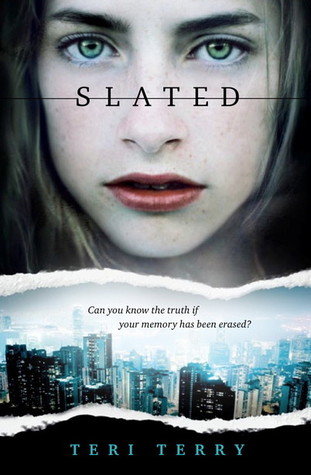
Slated by Teri Terry
Kyla has been given a second chance. If a criminal or gang member is under the age of 16, they can be slated which means having their memories completely wiped. Those who are slated are placed with families and start their lives again - under the constant supervision of their Levo, a device on their wrist that can't be removed and monitors their mood. Kyla is having a hard time adjusting. She swears she remembers things about her own life, but that's not possible. Is it?This was an enjoyable dystopian novel, and one that I'm curious about where it will go. I still have lots of questions about the world Kyla is in, but it didn't feel like poor world building was why I hadn't figured it out yet. Things were deliberately held back. The reader doesn't know anything more than Kyla does, and she's just starting to put things together. I hope when all is revealed it won't be disappointing!
The first thing I was trying to figure out, right from the beginning, is why there were so many under 16-year-old criminals. We are not that far into the future. It's 2054. It is still unclear what happened, but it involved some kind of massive gang uprising and violence, which was put down harshly by the government. There are still Antigovernment Terrorists (AGT). Do the terrorists recruit young children? Are gangs still prevalent? It seems that gang violence had been pretty much eradicated. Why still so many slated?
Spoilers
Labels:
dystopia,
family,
fiction,
friendship,
romance,
science fiction,
series,
YA
Wednesday, January 16, 2013
Waiting on Wednesday: Breaking Point by Kristen Simmons
After faking their deaths to escape from prison in Article 5, Ember Miller and Chase Jennings have only one goal: to lay low until the Federal Bureau of Reformation forgets they ever existed.
Near-celebrities now for the increasingly sensationalized tales of their struggles with the government, Ember and Chase are recognized and taken in by the Resistance—an underground organization working to systematically take down the government. At headquarters, all eyes are on the sniper, an anonymous assassin taking out FBR soldiers one by one. Rumors are flying about the sniper's true identity, and Ember and Chase welcome the diversion….
Until the government posts its most-wanted list, and their number one suspect is Ember herself.
Orders are shoot to kill, and soldiers are cleared to fire on suspicion alone. Suddenly Ember can’t even step onto the street without fear of being recognized, and “laying low” is a joke. Even members of the Resistance are starting to look at her sideways.
With Chase urging her to run, Ember must decide: Go into hiding…or fight back? (Summary from Amazon)
I loved Article 5 and how it developed and grew. So I definitely can't wait for the sequel and see how the story continues and how Chase and Ember's relationship develops.
Breaking Point comes out Feb. 12.
Labels:
action,
dystopia,
romance,
series,
waiting on wednesday
Wednesday, December 5, 2012
The Culling by Steven dos Santos
Lucian Sparks lives in a world ruled by the Establishment, a cruel, dictatorial government. Wanting to protect his four-year-old brother Cole, Lucian seeks out his childhood friend Cassius, who is now in a position of power, for help. But when Cassius thinks Lucian has chosen rebel Digory Tycho over him, he punishes Lucian by making both Digory and Lucian recruits, who are forced to compete against each other in a series of task. If a recruit fails, he is punished by choosing an incentive - a loved one - to be killed. For Lucian, it would be Cole.
It's The Hunger Games! Now with more flesh eating! Seriously, this didn't even try to pretend it wasn't completely ripping off The Hunger Games. Person only trying to protect a much younger sibling? Check. Person not interested in joining the rebellion, only trying to keep said younger sibling safe? Check. Young people forced to compete in Gladiator-type games at the hands of cruel dystopian government? Check. Young people forced to form alliances to survive, only to have to break those alliances and kill each other in order to protect their loved ones? Check.
So yeah, it was The Hunger Games, only this time with a male protagonist and a male-male romance. I did like that aspect of it, that falling in love with another man is not strange in this world. It was completely accepted as the norm. The Culling was also more graphically violent. I know, I know, The Hunger Games are all about kids killing kids, but honestly, the first two books are not especially graphically violent. The third one much more so. This was like the third one.
It's The Hunger Games! Now with more flesh eating! Seriously, this didn't even try to pretend it wasn't completely ripping off The Hunger Games. Person only trying to protect a much younger sibling? Check. Person not interested in joining the rebellion, only trying to keep said younger sibling safe? Check. Young people forced to compete in Gladiator-type games at the hands of cruel dystopian government? Check. Young people forced to form alliances to survive, only to have to break those alliances and kill each other in order to protect their loved ones? Check.
So yeah, it was The Hunger Games, only this time with a male protagonist and a male-male romance. I did like that aspect of it, that falling in love with another man is not strange in this world. It was completely accepted as the norm. The Culling was also more graphically violent. I know, I know, The Hunger Games are all about kids killing kids, but honestly, the first two books are not especially graphically violent. The third one much more so. This was like the third one.
Labels:
a little bit of horror,
action,
boy appeal,
dystopia,
family,
fiction,
friendship,
romance,
science fiction,
series,
YA
Wednesday, October 17, 2012
Waiting on Wednesday: The Darkest Minds by Alexandra Bracken
When Ruby wakes up on her tenth birthday, something about her has changed. Something alarming enough to make her parents lock her in the garage and call the police. Something that gets her sent to Thurmond, a brutal government "rehabilitation camp." She might have survived the mysterious disease that's killed most of America's children, but she and the others have emerged with something far worse: frightening abilities they cannot control.
Now sixteen, Ruby is one of the dangerous ones.
When the truth comes out, Ruby barely escapes Thurmond with her life. Now she's on the run, desperate to find the one safe haven left for kids like her--East River. She joins a group of kids who escaped their own camp. Liam, their brave leader, is falling hard for Ruby. But no matter how much she aches for him, Ruby can't risk getting close. Not after what happened to her parents.
When they arrive at East River, nothing is as it seems, least of all its mysterious leader. But there are other forces at work, people who will stop at nothing to use Ruby in their fight against the government. Ruby will be faced with a terrible choice, one that may mean giving up her only chance at a life worth living.
Sounds like it could be a bit of awesome, right? I mean rebellion, special abilities, romance? Should be delightful.
Darkest Minds comes out Dec. 18th.
Labels:
dystopia,
fantasy,
romance,
waiting on wednesday
Monday, October 15, 2012
Article 5 by Kristen Simmons
Article 1. The United States embraces the Church of America as her official religion.
Article 2. Literature and other media considered immoral are hereby banned and shall not be owned, bought, sold, or traded in any capacity.
Article 3. Whole families are to be considered one man, one woman, and child(ren).
Article 4. Traditional male and female roles shall be observed.
Article 5. Children are considered valid citizens only when conceived by a married man and wife.
It didn't always used to be like this, Ember remembers a time when people were allowed to practice their own religion and to speak their mind. Where books weren't contraband and she didn't have to worry about friendships being tested by the Moral Statutes. She remembers a time when she was in love with a boy named Chase, and life wasn't about getting by and food stamps. But when she and her mother are taken and separated because they've violated Article 5, and arrested by the one she loved the most, her world falls apart. Her one goal in life is to be reunited with her mother, but things are becoming more complicated as Chase sets her free but leads her to a different kind of freedom.
This was so complex yet so simple. The culture that Kristen Simmons created is well done, her world-building was so multi-layered. There were valid reasons behind everything, and you could see the history behind it. Nice.
The characters themselves were complex, their backstories and their the evolution of their personalities. Delightful. Ember is consistent in her focus and yet her personal growth is well plotted. Chase is fantastically enigmatic and loyally haunted. Essentially perfection.
I think what I like most about this, and why I call it a rather simple book, is the fact that while there's obviously a revolution going on around Ember and Chase, which they are rather centrally involved in. Most of the plot is about their traveling together as just a pair. They don't really know what's going on around them, they are more concerned with getting to their unknown destination and getting there alive. And yet they become a symbol of hope and rebellion, which I think is rather lovely.
Article 5 was excellent, and the sequel Breaking Point comes out Feb. 13th. Wahoo!
Article 2. Literature and other media considered immoral are hereby banned and shall not be owned, bought, sold, or traded in any capacity.
Article 3. Whole families are to be considered one man, one woman, and child(ren).
Article 4. Traditional male and female roles shall be observed.
Article 5. Children are considered valid citizens only when conceived by a married man and wife.
It didn't always used to be like this, Ember remembers a time when people were allowed to practice their own religion and to speak their mind. Where books weren't contraband and she didn't have to worry about friendships being tested by the Moral Statutes. She remembers a time when she was in love with a boy named Chase, and life wasn't about getting by and food stamps. But when she and her mother are taken and separated because they've violated Article 5, and arrested by the one she loved the most, her world falls apart. Her one goal in life is to be reunited with her mother, but things are becoming more complicated as Chase sets her free but leads her to a different kind of freedom.
This was so complex yet so simple. The culture that Kristen Simmons created is well done, her world-building was so multi-layered. There were valid reasons behind everything, and you could see the history behind it. Nice.
The characters themselves were complex, their backstories and their the evolution of their personalities. Delightful. Ember is consistent in her focus and yet her personal growth is well plotted. Chase is fantastically enigmatic and loyally haunted. Essentially perfection.
I think what I like most about this, and why I call it a rather simple book, is the fact that while there's obviously a revolution going on around Ember and Chase, which they are rather centrally involved in. Most of the plot is about their traveling together as just a pair. They don't really know what's going on around them, they are more concerned with getting to their unknown destination and getting there alive. And yet they become a symbol of hope and rebellion, which I think is rather lovely.
Article 5 was excellent, and the sequel Breaking Point comes out Feb. 13th. Wahoo!
Tuesday, October 2, 2012
Breathe by Sarah Crossan
Trees and oceans were destroyed, and oxygen levels plummeted. The only way to survive was to be one of the lucky ones selected to live in one of the pods, where the organization Breathe could pump air in. Many years later, Alina is a member of the Resistance, trying to regrow trees outside the pod, but the ministry is on to her. With the help of an unsuspecting Premium boy Quinn, and his suspicious auxiliary friend Bea, Alina escapes from the pod. Now they're all on the run, having learned the terrible secrets behind Breathe.
I enjoyed this. It was a good story, although things fell apart at the end a bit I thought. It has all the elements YA readers will like: dystopian future, fighting back against those in power, and a love triangle, of sorts. Quinn has a crush on Alina, who isn't interested, and Bea is in love with Quinn, who's oblivious. I guess that's not a triangle at all. It's a line of unrequited love.
I thought the world that had been created was good, although a little weak on how it got that way. All that's mentioned is that the population exploded, and more and more trees were cut down so housing could be built, under the assumption that the oceans could handle the oxygen needs, but it couldn't and the oceans sickened or something and then people started dying. It was a little weak and not all that clear. I'm not sure if that's just due to not great world building, or if we're being deliberately kept in the dark. I think it might be not great world building.
The world inside the pod is quite interesting though. We understand that there are pods such as this all over the world, and they operate of caste systems. The Premiums have the most money and the most access to air. They can afford to get extra air to do things like exercise. If a family goes over their designated air amount, they have to pay for it. If you're not a Premium, you're either a steward, who works for the government, or an auxiliary, which is pretty sucky. Auxiliaries are second class citizens and seemed to have very few rights.
Spoilers ahead
I enjoyed this. It was a good story, although things fell apart at the end a bit I thought. It has all the elements YA readers will like: dystopian future, fighting back against those in power, and a love triangle, of sorts. Quinn has a crush on Alina, who isn't interested, and Bea is in love with Quinn, who's oblivious. I guess that's not a triangle at all. It's a line of unrequited love.
I thought the world that had been created was good, although a little weak on how it got that way. All that's mentioned is that the population exploded, and more and more trees were cut down so housing could be built, under the assumption that the oceans could handle the oxygen needs, but it couldn't and the oceans sickened or something and then people started dying. It was a little weak and not all that clear. I'm not sure if that's just due to not great world building, or if we're being deliberately kept in the dark. I think it might be not great world building.
The world inside the pod is quite interesting though. We understand that there are pods such as this all over the world, and they operate of caste systems. The Premiums have the most money and the most access to air. They can afford to get extra air to do things like exercise. If a family goes over their designated air amount, they have to pay for it. If you're not a Premium, you're either a steward, who works for the government, or an auxiliary, which is pretty sucky. Auxiliaries are second class citizens and seemed to have very few rights.
Spoilers ahead
Sunday, September 2, 2012
What's Left of Me by Kat Zhang
Each person is born with two souls. The two souls share everything, from thoughts to feelings to control of the body. But usually one soul is dominate, and as the person grows older, the weaker soul fades away. But not always. Eva was suppose to fade away long ago, and now Addie is the only one who knows she's still there. Eva can't speak or move, she can only communicate with Addie. When a chance comes for Eva to regain some control, Addie and Eva must decide if it's worth the risk.
This seems like a very promising start to a series. It was something a little bit different. Yes, it's still sci fi book about kids trying to overthrow the government with a romance element, but it was different enough to make it fresh and exciting. And it's kind of cool that the love triangle is actually just between two people. It's just that only one of the souls in each person is attracted to the other. Drama!
This was mostly Eva's story, the soul that doesn't have control over her body. Eva is portrayed as more of a thinker, quieter, softer, while Addie is stronger with a shorter temper. Addie is the dominate soul, but she relies on Eva a lot to help her figure things out. We spend much more time with Eva's thoughts and feelings then we do Addie's
I wanted more world building (of course). I almost always want more world building. We get to know very little about the world Addie and Eva inhabit. We know they are living in America, but it isn't clear if it's an alternate America or an America of the future. If it's an America of the future, what happened that caused people to start being born with two souls? We know very little of the political situation inside or outside America. This part, I assume, was intentional, as there's a bit of a dramatic reveal at the end about the world outside of America, so I have hopes that things will be more threshed out in books to come.
Spoilers
This seems like a very promising start to a series. It was something a little bit different. Yes, it's still sci fi book about kids trying to overthrow the government with a romance element, but it was different enough to make it fresh and exciting. And it's kind of cool that the love triangle is actually just between two people. It's just that only one of the souls in each person is attracted to the other. Drama!
This was mostly Eva's story, the soul that doesn't have control over her body. Eva is portrayed as more of a thinker, quieter, softer, while Addie is stronger with a shorter temper. Addie is the dominate soul, but she relies on Eva a lot to help her figure things out. We spend much more time with Eva's thoughts and feelings then we do Addie's
I wanted more world building (of course). I almost always want more world building. We get to know very little about the world Addie and Eva inhabit. We know they are living in America, but it isn't clear if it's an alternate America or an America of the future. If it's an America of the future, what happened that caused people to start being born with two souls? We know very little of the political situation inside or outside America. This part, I assume, was intentional, as there's a bit of a dramatic reveal at the end about the world outside of America, so I have hopes that things will be more threshed out in books to come.
Spoilers
Monday, July 9, 2012
Prodigy by Marie Lu
Day and June are on the run from the Republic and are searching for the Patriots, the only ones who Day believes can help him get his little brother back. The Patriots are willing to help, but for a price. Day and June must help assassinate the new Elector of the Republic, which means June must return to the Republic where she is now an outlaw.
I was disappointed. Possibly because I loved the first one so much and was expecting something equally fabulous and it didn't quite deliver. I liked Legend so much because it felt fresh and new and different. You know how trends are. Harry Potter came out and made it big and suddenly wherever you turned there was a book about a kid realizing he was really a wizard. Then Twilight came out and everything was about falling in love with some supernatural creature and the issues that come with that. Then The Hunger Games came out and you can't swing a dead cat without hitting a book about how it's the future and everything sucks but one kid will rise above it.
And as I was hitting the peak of dystopia fatigue I read Legend and loved it. Prodigy did not keep the fresh new feel. In Prodigy, Day reluctantly joins the Patriots, who are trying to create a rebellion against the Republic. They want Day because people see him as the symbol of revolution and the fight against the Republic. All Day wants is to get his little brother back safe and run away with him and June to the Colonies. He reluctantly becomes the Patriot's symbol to make this happen. Sound familiar? Yeah, straight up Hunger Games. Hardly anything is different, just a reversal in gender roles.
I continue to like and be interested in June. She's a great character, although we didn't get to see a whole lot of change or growth in her. Actually, there wasn't a whole lot of new information given in the book at all. We got to learn more about how the Trails started, but we still don't know what's going on with the disease experimentation or why they saw Day as such a threat, which was one of the big questions from the first book. We didn't get to learn anymore about June's brother or what her parent's were up to.
I did like getting to see how the rest of the world views the Republic. Inside the Republic, they seem so all-powerful, but outside, they're just a small rogue country. I liked that a lot. Both Day and June were shocked to learn this. I also liked how the Colonies were not the golden utopia Day had always pictured. There are plenty of issues there too, which leads to Day and June's ultimate decision about whether they'll help the Patriots overthrow the Republic or not.
Marie Lu is a new author and is coming off a huge success from Legend, which I'm sure is super stressful, so hopefully she'll find her freshness again in the third one.
Prodigy comes out January 29, 2013.
I was disappointed. Possibly because I loved the first one so much and was expecting something equally fabulous and it didn't quite deliver. I liked Legend so much because it felt fresh and new and different. You know how trends are. Harry Potter came out and made it big and suddenly wherever you turned there was a book about a kid realizing he was really a wizard. Then Twilight came out and everything was about falling in love with some supernatural creature and the issues that come with that. Then The Hunger Games came out and you can't swing a dead cat without hitting a book about how it's the future and everything sucks but one kid will rise above it.
And as I was hitting the peak of dystopia fatigue I read Legend and loved it. Prodigy did not keep the fresh new feel. In Prodigy, Day reluctantly joins the Patriots, who are trying to create a rebellion against the Republic. They want Day because people see him as the symbol of revolution and the fight against the Republic. All Day wants is to get his little brother back safe and run away with him and June to the Colonies. He reluctantly becomes the Patriot's symbol to make this happen. Sound familiar? Yeah, straight up Hunger Games. Hardly anything is different, just a reversal in gender roles.
I continue to like and be interested in June. She's a great character, although we didn't get to see a whole lot of change or growth in her. Actually, there wasn't a whole lot of new information given in the book at all. We got to learn more about how the Trails started, but we still don't know what's going on with the disease experimentation or why they saw Day as such a threat, which was one of the big questions from the first book. We didn't get to learn anymore about June's brother or what her parent's were up to.
I did like getting to see how the rest of the world views the Republic. Inside the Republic, they seem so all-powerful, but outside, they're just a small rogue country. I liked that a lot. Both Day and June were shocked to learn this. I also liked how the Colonies were not the golden utopia Day had always pictured. There are plenty of issues there too, which leads to Day and June's ultimate decision about whether they'll help the Patriots overthrow the Republic or not.
Marie Lu is a new author and is coming off a huge success from Legend, which I'm sure is super stressful, so hopefully she'll find her freshness again in the third one.
Prodigy comes out January 29, 2013.
Labels:
boy appeal,
dystopia,
fiction,
series,
YA
Wednesday, June 6, 2012
Waiting on Wednesday: The Forsaken by Lisa M. Stasse
As an obedient orphan of the U.N.A. (the super-country that was once Mexico, the U.S., and Canada), Alenna learned at an early age to blend in and be quiet—having your parents taken by the police will do that to a girl. But Alenna can’t help but stand out when she fails a test that all sixteen-year-olds have to take: The test says she has a high capacity for brutal violence, and so she is sent to The Wheel, an island where all would-be criminals end up.
The life expectancy of prisoners on The Wheel is just two years, but with dirty, violent, and chaotic conditions, the time seems a lot longer as Alenna is forced to deal with civil wars for land ownership and machines that snatch kids out of their makeshift homes. Desperate, she and the other prisoners concoct a potentially fatal plan to flee the island. Survival may seem impossible, but Alenna is determined to achieve it anyway. (Summary from GoodReads)
Dystopia and violence? So there. Also can we just talk about how beautiful this cover is? It's more than a little awesome. Right?
The Forsaken comes out July 10th.
Labels:
action,
dystopia,
series,
waiting on wednesday
Monday, June 4, 2012
Under the Never Sky by Veronica Rossi
After being exiled from her underground commune of Reverie, Aria believes that she has a matter of days before she dies outside in the desert wasteland. But she feels that she must attempt by any means necessary to get back in, and find out what has happened to her mother. In the end, she must rely on the savage Outsider Perry for help. They make a deal in order for Aria to survive and Perry to find his kidnapped nephew. Each has their own agenda, negative stressors from home, and growing emotions. They must soon decide whether they can keep their goals separate from their emotions.
I really enjoyed this, but not how I expected to. The first thing that drew me in was the plot. It was really quite wonderful, full of twists that I never really expected and jumps that made me want to read more instead of annoying me. I loved the secondary characters. They were all super well-developed, with back-stories that I totally want to find out about. I found the world that Veronica Rossi to be pretty well-developed, she had some nicely put together cultural elements. I wouldn't say it's as fully developed like Suzanne Collins' Hunger Games, but it has a lot of potential.
Here was my niggle: I thought that Aria was going to be this deep, complex, smart character, instead I found her to be kind of whiny and oblivious. Thankfully she develops to be mostly likable by the end, but the person that really made the book for me was Perry. He was so in tune with himself, what he was, and his self-awareness really lends itself to the development of the story. Just so we're clear, the narration of the story switches between Aria and Perry every other chapter. I just really really enjoyed Perry's narrations. And I thought it was interesting to find that Veronica Rossi had an easier time writing Perry's part:
I just totally channeled Perry right from the beginning. At one point had the story all in his POV. I'm really glad I picked up Aria's voice, and she's as fun/difficult for me to write as Perry now. It just took me a little longer to find her.
But I did think it was interesting that she had more fun writing Aria's part. Which I guess I could see, considering that Aria probably has a greater emotional and personal journey to go on and she grows more. Anyways, I can't wait for the next book to come out. Supposedly it's coming out sometime in the new year... maybe there'll be an ARC at ALA! Fingers crossed!
I really enjoyed this, but not how I expected to. The first thing that drew me in was the plot. It was really quite wonderful, full of twists that I never really expected and jumps that made me want to read more instead of annoying me. I loved the secondary characters. They were all super well-developed, with back-stories that I totally want to find out about. I found the world that Veronica Rossi to be pretty well-developed, she had some nicely put together cultural elements. I wouldn't say it's as fully developed like Suzanne Collins' Hunger Games, but it has a lot of potential.
Here was my niggle: I thought that Aria was going to be this deep, complex, smart character, instead I found her to be kind of whiny and oblivious. Thankfully she develops to be mostly likable by the end, but the person that really made the book for me was Perry. He was so in tune with himself, what he was, and his self-awareness really lends itself to the development of the story. Just so we're clear, the narration of the story switches between Aria and Perry every other chapter. I just really really enjoyed Perry's narrations. And I thought it was interesting to find that Veronica Rossi had an easier time writing Perry's part:
I just totally channeled Perry right from the beginning. At one point had the story all in his POV. I'm really glad I picked up Aria's voice, and she's as fun/difficult for me to write as Perry now. It just took me a little longer to find her.
But I did think it was interesting that she had more fun writing Aria's part. Which I guess I could see, considering that Aria probably has a greater emotional and personal journey to go on and she grows more. Anyways, I can't wait for the next book to come out. Supposedly it's coming out sometime in the new year... maybe there'll be an ARC at ALA! Fingers crossed!
Wednesday, May 23, 2012
The Girl Who Owned a City by O.T. Nelson, adapted by Dan Jolley, art by Joelle Jones
A world-wide plague killed everyone under the age of 13. There are only children left. Lisa, her brother Todd and the other children in her Grandville neighborhood are struggling to survive. Lisa is smarter than most. She won't let fear get the better of her. She knows if they're going to make it, they need to organize with the other children and figure out a way to find food and protect themselves from wandering gangs. The first step is finding a place where they can all live but is easy to protect, and Lisa thinks she's found the perfect place.
This is the graphic novel adaptation of O.T. Nelson's 1970s novel of the same name. I remember reading it in 7th grade. Possible the original "there's a virus and there are only children left" YA dystopia novel? There are so many now it's hard to keep track. Even though it's almost 40 years old, it's still an excellent one. No updates needed.
With only children left, there is no electricity, food production, medical help, etc. The kids have to figure out how to care form themselves completely, starting with getting food. Lisa is smart and determined. She knows how to find what she and her brother need and is frustrated at the people who take things from her because they aren't smart enough to get it themselves. She organizes the other neighborhood children, in particular to protect themselves from a local gang. When her house is burned down, she realizes that they need to be somewhere they can fortify, and she moves her neighborhood to the local high school.
Lisa is a good leader. She has a very difficult job that no one else really wants, although she angers people by always referring to Glenbard as "her" city. Of course, as soon as she gets things up and running, they are attacked by gangs that want what they have. Lisa is prepared for this, and the children fight back.
It's such an interesting psychological look at people. Some people collapse under difficult situations, some people rise up, and some people survive by taking things from others. The gangs that attack Glenbard don't know how to continue to run things (as we see when Lisa is shot and injured and her city is taken over). Really, they're just as scared as everyone else, but have found a different way to deal with it. Rather than finding people to work with, they find people to take control of.
O.T. Nelson never wrote anything else. We don't know what happened to this world. Did they survive and create a new civilization? Did everyone die when they turned 13, or is the virus gone? Was Lisa's city able to fight off the King of Chicago? All unanswered questions, from the days when ever book was not a series and you had to imagine what happened yourself.
A great story and a fascinating look at people.
This is the graphic novel adaptation of O.T. Nelson's 1970s novel of the same name. I remember reading it in 7th grade. Possible the original "there's a virus and there are only children left" YA dystopia novel? There are so many now it's hard to keep track. Even though it's almost 40 years old, it's still an excellent one. No updates needed.
With only children left, there is no electricity, food production, medical help, etc. The kids have to figure out how to care form themselves completely, starting with getting food. Lisa is smart and determined. She knows how to find what she and her brother need and is frustrated at the people who take things from her because they aren't smart enough to get it themselves. She organizes the other neighborhood children, in particular to protect themselves from a local gang. When her house is burned down, she realizes that they need to be somewhere they can fortify, and she moves her neighborhood to the local high school.
Lisa is a good leader. She has a very difficult job that no one else really wants, although she angers people by always referring to Glenbard as "her" city. Of course, as soon as she gets things up and running, they are attacked by gangs that want what they have. Lisa is prepared for this, and the children fight back.
It's such an interesting psychological look at people. Some people collapse under difficult situations, some people rise up, and some people survive by taking things from others. The gangs that attack Glenbard don't know how to continue to run things (as we see when Lisa is shot and injured and her city is taken over). Really, they're just as scared as everyone else, but have found a different way to deal with it. Rather than finding people to work with, they find people to take control of.
O.T. Nelson never wrote anything else. We don't know what happened to this world. Did they survive and create a new civilization? Did everyone die when they turned 13, or is the virus gone? Was Lisa's city able to fight off the King of Chicago? All unanswered questions, from the days when ever book was not a series and you had to imagine what happened yourself.
A great story and a fascinating look at people.
Saturday, May 19, 2012
The Drowned Cities by Paolo Bacigalupi
Mahlia and her friend Mouse are war refugees. Mouse saved Mahlia after the Army of God cut off one of her hands. The two fled the Drowned Cities and have been living on the outskirts where it's safer. But not safe. They discover a wounded half-man, a born killer that the army is after. They strike up a deal, they will help the half-man Tool, and in exchange, he will help them run north. When Mouse is captured and recruited into the army, Mahlia must decide what the right thing to do is: run and save herself, or go after Mouse and face almost certain death.
So good. So depressing. Oh man, so depressing. But so good. Dystopias are depressing in general, but this hit harder than most other ones I've read. This world seemed more feasible, more real. Most other dystopias don't actually have a sense of possible reality for me. But wow, did this one. So depressed.
Labels:
dystopia,
fiction,
friendship,
science fiction,
series,
serious issues,
war,
YA
Subscribe to:
Posts (Atom)