Showing posts with label historical fiction. Show all posts

Thursday, April 23, 2015

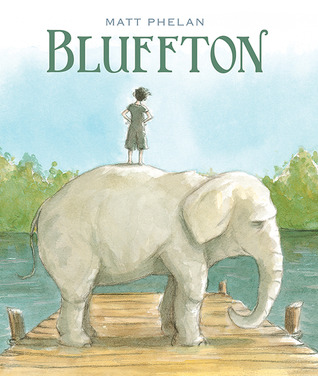
Bluffton: My Summer with Buster by Matt Phelan

It's 1908, and not much happens in Muskegon, Michigan.  But all that changes when a troupe of vaudeville performers come to summer not far from Muskegon.  Henry can't believe his eyes.  The elephants, zebras, and the kids who travel with their families!  What a life!  Henry befriends Buster, a kid his age who is part of his family's act.  Henry wants Buster to teach him all his tricks, but all Buster wants is to play baseball and pull some pranks.

Henry is a fictional character, but all the vaudeville people mentioned in the book are real, and they really did summer at Bluffton where Joe Keaton, Buster's father, founded The Actor's Colony.  Buster, of course, is Buster Keaton, famous comedian and film star.  Before he became that famous film star, we learn, he was part of a family act where he was "the human mop."  He got throw around, took lots of falls, and got right back up again.

Henry is jealous of Buster.  Henry thinks his life is boring.  Here he is in this nothing little town, where nothing every happens.  His father owns a store.  He helps his father in his store.  He goes to school.  That's his life.  But Buster!  Buster gets to travel the world!  He can do all sorts of tricks and falls.  He can juggle.  He meets all kind of interesting people.  He's personable and friendly.  Henry wants to be like him.

Buster, we the reader can see, does not think he's quite so lucky.  He wants to spend his summer, the only time he doesn't have to perform, playing baseball.  He doesn't want to teach Henry falls and tricks.  He doesn't want to do them when he doesn't have to.  We can tell Buster wishes he'd had more schooling.  Perhaps more of a "regular" life.  That maybe he doesn't want to be in vaudeville forever, but Henry can't see that.

There's a lovely moment in the book where Henry talks to his father about not wanting to be a store keeper.  His father tells him he never expected him to be.  He wants Henry to do whatever will make him happy.

The art is done in lovely pale water color.  It invokes a feeling of "another time."  There are many wordless panels where everything we need is in a look or gesture.  A beautiful book.  Might take some pushing to get kids to read it.  It might not be one they'll just pick up.  Sell it by talking about the elaborate pranks Henry and Buster pull on the school principal.

Saturday, November 1, 2014

The Paper Cowboy by Kristin Levine

It's 1953, and Tommy just wants to hang out with friends, be a cowboy and pretend to fight communists.  But then Tommy's older sister Mary Lou is terribly burned in an accident, and things begin to fall apart.  Tommy's mother, who was always moody, has violent outbursts and beats Tommy.  Tommy starts bullying other kids at school, and frames a shopkeeper for being a communist.  Rumors of communism spread out of control, and Tommy doesn't know what to do to set things right.

This was very well done.  The story is about Tommy and his family, but it's all the more powerful for being set against a backdrop of McCarthyism.  Tommy doesn't realize the consequences of his actions when he puts a communist newspaper in Mr. McKenzie's store.  He's angry and wants to do something mean.  It's shocking to him how quickly people turn away from Mr. McKenzie and boycott his store, even when it's made clear it was a prank.  Everyone is so afraid of being labeled a communist.  Tommy decides to find out who the communist newspaper actually belonged to, thereby finding the real communist and clearing Mr. McKenzie's name.  Every time he's ready to accuse someone else, he realizes things were not what they seem to be.  It takes a while for Tommy to learn not to make quick accusations, and also, that having different beliefs don't make a person bad.

The story of Tommy's family is a sad one.  Today, Tommy's mother would probably be diagnosed with a manic depressive disorder.  There are scenes of her staying up all night cleaning or cooking, and then spending days refusing to get up.  She could go from sweet to violent in a second, and seemed paranoid about people making fun of her.  After Mary Lou is burned and hospitalized, Tommy's mother because more physically violent.  His father doesn't know how to deal with it, and rather than protecting his children he stays away from home as much as possible.  It falls on Tommy to take care of his two little sisters, and take up Mary Lou's paper route.

Tommy, who has no one to vent his feelings to, turns into a bully at school.  In particular he picks on the new boy, Sam, who is Mr. McKenzie's son.  Tommy and his friend Eddie are cruel to Sam, making fun of him, tricking him, and getting him into trouble.  It was an interesting perspective to see where a bully might come from.  It doesn't excuse Tommy's actions, but it was understandable that he might lash out in this way.

Things finally reach a breaking point and Tommy has to make some hard choices.  He learns to ask for help and that accepting charity is not a bad thing.  There are people around him who can support him.

It sounds like there's a lot going on in this book, and there is, but it all worked together perfectly.  Great historical fiction read.

Monday, October 20, 2014

The Watcher by Joan Hiatt Harlow

It's 1942 in Berlin, Germany.  Wendy has just arrived in Berlin with her newly found mother, Adrie.  Wendy's grown up her whole life in America and speaks no German.  As happy as she is to be with Adrie, it is hard for Wendy to transition to being a German girl.  The war, which seemed so remote in America, is the focus of everything in Berlin, and many things Wendy doesn't understand.  It seems she has two choices.  She can close her eyes to what's happening, or she can do something about it.

The Watcher is a companion novel to Shadows on the Sea, which I hadn't read.  Wendy was a supporting character in that book, and I guess at the end she disappears with her newly discovered mother to Germany.  I went a lot of the book thinking that it was going to turn out that Adrie wasn't actually Wendy's real mother, that it was a trick to get Wendy to Germany because they needed an American girl for some secret task.  Adrie works for the German military intelligence unit as a spy.  I guess if I'd read the other book I would have know that it was true that Adrie was Wendy's real mother.  Although honestly, I think it would have made more sense if my idea had ended up being true.

This book didn't work for me very well.  I thought it was confusing and choppy.  I didn't think it made sense for Adrie to decided that 1942 was the time to let Wendy know she was her real mother and bring her to Germany.  Even if she was completely convinced Germany was going to win the war.  Why wouldn't she have waited until after?  The story of Wendy's father didn't really make sense.  Wendy's father was Jewish and they were married briefly but then her father was jailed and Adrie got a divorce and someone was able to make it look like their marriage had never happened and then Adrie got remarried and his name is the name on Wendy's birth certificate, but then Adrie decided to send her daughter to America to be safe, and also to pretend that she was her aunt and that her sister and her husband were Wendy's parents.  Yeah.  Confusing.  And also, it's Germany.  You think a member of the Germany military intelligence unit wouldn't have been carefully investigated and it wouldn't have been found out she was married to a Jew?  I don't think so.

So the whole premise I found a bit shaky.  I liked that the book focused on a couples aspects of WWII that many people would not have heard about.  Wendy ends up volunteering at a Lebensborn Nursery.  These were places were children who had been kidnapped from other countries because they had the correct Aryan look were taken to be raised to be good German citizens.  Lebensborn also housed the children of unwed German women and German soldiers who had been approved as having German ancestors.  The children born were taken from their mothers and were considered to belong to the state.  At the nursery, Wendy meets Johanna, a girl who has been assigned to Lebensborn for "reeducation."  She is a Jehovah's Witness (Bibelforscher), one of the many groups considered undesirable by the Nazis.  All Johanna would have to do would be to sign a piece of paper swearing her loyalty to Hitler and Germany and renouncing her religion, but she refuses to do so.

As Wendy befriends Johanna and realizes that Johanna could be sent off to a concentration camp, or killed, for refusing to renounce her religion, Wendy begins to question whether her plan of ignoring the bad things happening around her is going to be possible.  Wendy also becomes friends with a blind young man she meets in the park, whose grandfather knows all about Wendy's real father.  Wendy also adopts a German Shepard puppy that couldn't make it as an SS dog.

Wendy decides she must escape from Germany and get back to the United States, and the rest of the book is planning and executing the escape.  I didn't find it especially gripping or interesting.

So, thumbs up on looking at aspects of WWII that we don't often see in middle grade books.  But the books itself I would pass on.

The Watcher comes out November 4, 2014.

Sunday, October 19, 2014

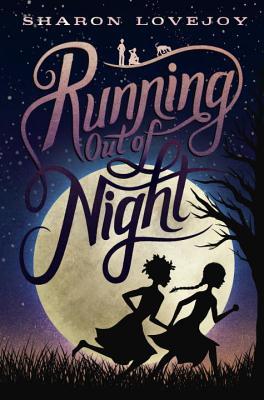
Running Out of Night by Sharon Lovejoy

She's never had a name, and she's never known a friend.  She takes care of her father's house and is treated brutally.  Everything changes when Zenobia, a runaway slave, stumbles into her home.  Zenobia names the girl Lark, and the two set out together, determined to find their freedom.

Such an interesting story.  Very different from other middle grade of YA stories I've read about slaves running during the 1800s.  First there is the aspect that Lark is white, but no less a slave than Zenobia is.  She realizes though, that while she was cruelly treated, it was still nothing like what Zenobia and other Black slaves suffered.

Unusually, story begins and ends in Virginia.  Zenobia and Lark run, but they never actually get very far away from Lark's home, despite all their traveling and hardships.  This book really showed the ruthless determination that slave catchers had, especially when a big reward was involved.  And Lark's father is not about to let her go so easily.  We never actually see any of the characters safe to freedom.  We never see them get out of Virginia.

Zenobia knows about the Underground Railroad, but despite that, it's not so easy to jump on.  And even when they do find a safe house, they're not safe.  That was definitely a theme of the book, looking for safety and freedom, never quite finding it, never stopping hoping it's out there somewhere.

Zenobia and Lark are taken in by a Quaker woman, Auntie, who shelters them and arranges for Zenobia's escape to Canada.  Canada, at this point in history, is pretty much the only safe place to run to, because even if a slave made it to the North, they could still be captured and returned.  The Quakers believe in nonviolence and are against slavery.  Many in the Quaker community are becoming reluctant to help runaways, because the runaways' harsh treatment is coming down on them too.  Indeed, when Zenobia is discovered and taken, Auntie is taken too.  She never stops believing that nonviolence is the only answer though.

Lark undergoes some changes throughout the book.  At first, she's too afraid to have anything to do with Zenobia.  She doesn't want any more trouble then she already has.  But she can't help but see Zenobia's fear is similar to her own.  And Lark starts to think about why she's never left the people who hurt her.  She realizes she's been a slave too, and that she doesn't have to anymore.  She can care and help other people, too.

The book ends with hope.  And we are left so wanting these characters to find their Promised Land, after everything they've been through.  Great historical fiction read.

Running Out of Night comes out November 1, 2014.

Wednesday, August 13, 2014

The Night Journey by Kathryn Lasky

Rachel isn't supposed to ask her great-grandmother, Nana Sashie, about her past.  Her parents say it upsets her.  But Nana Sashie seems to want to tell Rachel her story.  Rachel begins sneaking up to Nana Sashie's room whenever she can, and listens in amazement to Nana Sashie's story of her family's escape from tsarist Russia.

There are so many books about the Holocaust, and those are very important books.  There are fewer books about tsarist Russia, and how Jews were treated during this time period.  There are fewer books about Jews who were subject to pogroms by Russian soldiers that could happen at any moment, and the fact that despite this treatment, Jewish men were forced to serve in the army.  Books like these are important so that history is not forgotten.

Rachel is a typical pre-teen.  Her parents annoy her at times.  She isn't thrilled with having to sit with her great-grandmother, who isn't always lucid.  But when Nana Sashie begins talking about how her family escaped from Russia, Rachel is pulled into the story.  She had no idea that this was part of her family history.

Nana Sashie tells Rachel what it was like to live in Russia during this time period.  Jews were constantly afraid.  They never knew when a pogrom might happen.  At any moment their village could be full of Russian soldiers who would kill everyone and burn down the village.  And there was no one to stop them, and there were no consequences for the killers.  Nana Sashie was just a little girl when her father decided they must leave Russia.  But the family, made up of Sashie, her mother and father, her two younger siblings, her grandfather and her aunt, couldn't just leave.  They couldn't just stroll over the border.  They would have to find a way to sneak themselves close enough to the border, and then bribe a guard to get them across.  It would be very dangerous.  They would need a plan.

Nana Sashie tells Rachel how she came up with much of the plan on her own, even though she was a little girl.  The escape had many frightening moments, when it seemed like they might be caught, which would certainly mean death.  But they made it.

Rachel begins to see how important it is to Nana Sashie that she tells someone this story.  It's important that someone knows and someone remembers what happened so long ago.  Rachel begins to write down her great-grandmother's story so it will never be forgotten.

Saturday, July 26, 2014

Ninth Ward by Jewell Parker Rhodes

Lanesha lives in New Orleans' Ninth Ward with Mama Ya-Ya who's cared for her since she was born.  Lanesha doesn't really have any contact with her uptown family, but she doesn't let it bother her.  Mama Ya-Ya is all she needs.  Mama Ya-Ya has visions and see ghosts.  When Mama Ya-Ya has a vision about upcoming hurricane Katrina that leaves her unable to take care of Lanesha, Lanesha knows it's time for her to help them both.

This was a beautiful, lyrical story.  It's not told in verse, but the language itself had a poetic, flowing quality to it.  Lanesha is a strange child, and she knows it.  She doesn't have any friends at school, all the kids think she's weird.  Lanesha loves math (she practices for fun) and sees ghosts, like the ghost of her mother who died giving birth to her.  Many people are scared of Mama Ya-Ya and think she's a witch.  Mama Ya-Ya was a midwife, but people stop wanting her to deliver their babies.

Lanesha is happy and secure inside her small world with Mama Ya-Ya, despite her lack of friends and the fact her blood family want nothing to do with her.  She has everything she needs, and Mama Ya-Ya takes care of her. 

As the hurricane approaches, Mama Ya-Ya starts to act strange.  She's had a vision she doesn't understand.  She keeps saying, "the hurricane is not the problem."  Lanesha is worried.  Mama Ya-Ya has never acted like this before.  She's never not taken care of things.  So it falls to Lanesha to prepare for the hurricane, and it's Lanesha that keeps them safe.

After the hurricane, Lanesha's one friend, TaShon, who lives across the street from her comes back, having lost his family while taking shelter in the Superdome.  They are together when the levees break and the water starts to rise.  By this point, Mama Ya-Ya is sick and Lanesha and TaShon must work together to survive.

The ending of the book was hopeful but sad.  We feel Lanesha's triumph at having survived and taken care of herself and TaShon, but we don't know what will happen to her.  And we, the reader, know all the pain that will be coming in New Orleans.  But we're left feeling that Lanesha will be all right.  She is an exceptional child.  She will make it through.

Wednesday, June 25, 2014

Climbing the Stairs by Padma Venkatraman

Vidya is growing up in British occupied India during 1941.  She loves school and sports and her family.  When a tragedy hits her family that Vidya blames herself for, her family must move in with her extended family, who is very traditional.  The men live upstairs, and the women live downstairs and serve the men.  Vidya is afraid that soon she'll be married off and never finish school or fulfill her dream of going to college.

This looked at a side of history we rarely see: India during WWII.  India is still under British rule, and England is involved in the war.  There were all-Indian troops under British leadership that are rarely heard about.

While WWII is going on, India is involved in their own fight for freedom against British rule.  Lead by Gandhi, this fight was largely a non-violent one.  Vidya's father strongly believes in the non-violent approach, although Vidya's brother questions whether it is the right way.

Tuesday, April 1, 2014

Navigating Early by Clare Vanderpool

It's shortly after WWII, and Jack Baker finds himself in a boys' boarding school in Main, far away from his home in Kansas.  There he meets Early Auden, a strange boy with a fascination with the number pi.  During school vacation, Jack and Early are the only ones left at school, and they head out onto the Appalachian Trail on a quest.

This reminded me a bit of Francesca Lia Block's Love in the Time of Global Warming.  Not in writing style, of course.  But in both books we have a story, in LITTOFW it was The Odyssey, in Navigating Early it was the story of Pi, and the characters in the book go off on a journey that perfectly mirrors the story they read/heard/told.  I enjoyed Navigating Early much more.

It's an odd little book, one I think that's probably going to have more appeal to adults than middle grade kids, but I could be wrong about that.  It does have some boy appeal in two guys going off on an adventure.

Jack is torn up about the loss of his mother, although he tries not to show it.  He hardly knows his navy father, recently returned from the war, and his father is not the best at comfort and talking.  Jack feels lost and adrift, and the Main boarding school isn't helping to anchor him.

Although Jack is casual friends with the other boys, Early is the only one who really talks to him.  Early is odd.  He's probably has Autism in some form.  That's just my guess, it's not actually said in the book, that wouldn't have been appropriate for the time period.  Early has a number of characteristics that would fit though.  His father is recently dead, and he's living in the school basement, hardly ever going to class, and no one seems to care enough to do anything about it.  Early is adrift too, but in a different way.  What grounds him is the number pi.  In the never-ending numbers, Early can read a story, about a boy called Pi that loses his way, but finds his way home.

Early's brother has died in the war.  But Early is convinced his brother isn't dead, and that he's tied up in the story of Pie.  If only the story can have an ending, if Pi can find his way home, Early's brother will be able to as well.

Jack goes along with Early, mostly to not be left behind and alone.  Their journey mirrors Pi's journey, all the twists and turns, the meeting of strange characters and escaping danger.  Early is unflaggingly determined, Jack is skeptical.  The journey allows both boys to anchor themselves, although perhaps in unexpected ways.

I liked both the characters of Jack and Early.  They were well developed and unique and their actions were always believable.  The story surprised me and kept me interested.  Although there is action and adventure and even pirates, for heaven's sake, it's still overall a very quiet, thoughtful sort of book.

Tuesday, February 25, 2014

The Kingdom of Little Wounds by Susann Cokal

On the eve of Princess Sophia’s wedding, the Scandinavian city of Skyggehavn prepares to fete the occasion with a sumptuous display of riches: brocade and satin and jewels, feasts of sugar fruit and sweet spiced wine. Yet beneath the veneer of celebration, a shiver of darkness creeps through the palace halls. A mysterious illness plagues the royal family, threatening the lives of the throne’s heirs, and a courtier’s wolfish hunger for the king’s favors sets a devious plot in motion.

Here in the palace at Skyggehavn, things are seldom as they seem — and when a single errant prick of a needle sets off a series of events that will alter the course of history, the fates of seamstress Ava Bingen and mute nursemaid Midi Sorte become irrevocably intertwined with that of mad Queen Isabel. As they navigate a tangled web of palace intrigue, power-lust, and deception, Ava and Midi must carve out their own survival any way they can (Goodreads).

The book description makes it seems like there's some kind of supernatural power at work here.  There isn't.  The Kingdom of Little Wounds won a Printz Honor.  It is published by Candlewick, which only publishes YA and children's books.  The Kingdom of Little Wounds is not a YA book.  Not in any way.  I think someone at Candlewick really wanted to publish this, and so it got marketed as YA, when in truth, it is not.


Sunday, February 9, 2014

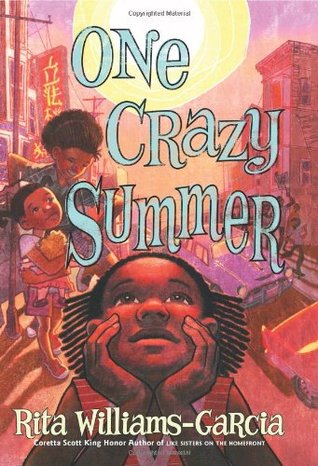
One Crazy Summer by Rita Williams-Garcia

Delphine and her two sisters, Vonetta and Fern are leaving Brooklyn for California to visit, for the first time, the mother that abandoned them.  It's the summer of 1968, and the girl's mother, Cecile, wants nothing to do with them.  Delphine and her sisters spend their days at a summer camp being run by the Black Panthers.

Delphine has always taken care of her sisters.  She has her father, and her father's mother who lives with them, but she's always been the mother to her little sisters.  She feels more grown up then she really is, like she always has to make careful, thought out decisions.  She can't just be a kid.  Delphine sees things in black and white.  After attending the Black Panther camp, she starts to realize there's a lot of gray.  In the events that are happening around them, and in her mother as well.

Their mother went from being really nasty to sort of being fond of the girls awfully fast.  I mean, Cecile wasn't just like, "This wasn't my idea and I'm not pleased."  She was flat out mean and cruel to them.  Like, not feeding them cruel.  Like telling them she didn't want them then and didn't want them now.  How on Earth did Cecile ever agree they could even stay with her?  Why did the girl's father think this was a good idea?  It seems like a terrible choice!

Delphine and Cecile certainly have a moment when Cecile asks Delphine why she couldn't do the one thing she (Cecile) needed her to do and Delphine finally goes off on her.  She points out the she's 11, for heaven's sake, and she always has to do everything because Cecile wasn't there. That changes their relationship some.   I had been wanting Delphine to tell Cecile off for a while.  That woman was selfish!

We learn more about where Cecile came from, and it was a sad story.  I could certainly empathize why she wouldn't feel connected to her children.  But that's only going to help her kids understand a little.  All they know is that they don't have a mom around.  I'm not sure what a middle grade student's reaction would be to that story.  Would they be able to sympathize with her at all?  Or would they not be able to get it?

The girls all do some growing up over the course of the summer.  Delphine, in particular, learns to be more flexible and take more risks.  It was a good coming of age book set against a historical backdrop.  You certainly get a feel for what it was like in Oakland in 1968, and the discrimination people of color faced.  It also helped to show that while the Black Panthers were a militant group, they also focused on things like education and helping people get food who needed it.

Tuesday, January 14, 2014

The War Within These Walls by Aline Sax, illustrated by Caryl Strzelecki

A young boy and his family are forced into the Warsaw ghetto, along with all the Jews of Poland.  After years, the Nazis prepare to liquidate the ghetto, and some of the Jews prepare to fight back.

It's not a graphic novel, exactly.  Although I think I'd shelve it with graphic novels, because I think that's where someone would look for it.  It's more an illustrated novels.  It's a beautifully put together book.  The words and illustrations are kept separate.  I found this allowed me to focus deeply on both words and images without getting distracted by one or the others.  Sometimes words appeared on black pages, all alone.  Sometimes the text was very short, other times it would be a whole page.

The illustrations were powerful.  They were done in black and white and were made up of hundreds of individual line strokes.  The illustrations were so full of emotion.  You could feel the pain and despair, the hopelessness and darkness these people were feeling.

In the story we follow the young boy and his family, first as the Nazis move into Poland and restrictions are put on Jews, and then to the entire Jewish population being moved into the ghetto.  The ghetto was so crowded, and there was so little food coming in, everyone was slowing starving to death, or being wiped out by disease.  People actually volunteered to get on the Nazi trucks (which took them to concentration camps) in the hopes they were being taken somewhere better.

The boy uses the sewers to sneak out of the ghetto and bring food to his family, until the Nazis begin using flame throwers to kill the smugglers in the sewers.  Then he is afraid to do anything, until he meets Mordechai Anielewicz, who is organizing Jews to fight back.  They know they cannot win, but they decided they will not quietly submit to death any longer.

Very powerful and beautifully done.

Monday, January 6, 2014

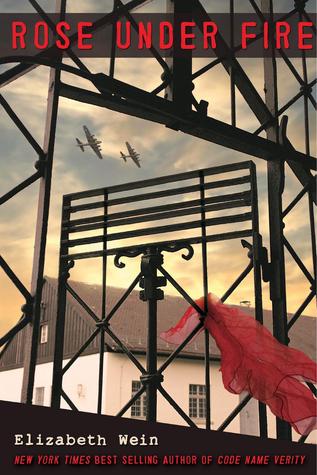
Rose Under Fire by Elizabeth Wein

American ATA pilot Rose Justice is flying an Allied fighter plane from Paris to England for repairs when she is captured by the Nazis.  She is sent to Ravensbruck, a women's concentration camp where women have been used like rats for medical experimentation.

This was a companion book to Code Name Verity.  It picks up not long after the events of Code Name Verity, in 1945.  It focuses on a new character, Rose, but Rose works for the same Air Transport Auxiliary organization that Julie did and where Maddie still is.

I had some issues with Code Name Verity, mainly the framing device.  I just couldn't buy into it, and while I thought it was great how it all came together, I never really got into it because I found the whole premise completely improbable.  I was worried it would be the same with this one.  The book blurb tells us that Rose is captured and sent to a concentration camp.  I was worried that Rose was actually going to be journaling from the camp!  But she was not.  The diary starts before she's captured, and after she escapes uses her journal to tell her story.

There were a couple instances that took me out of the story and didn't seem to fit in with the terrible realism the story was showing.  The dramatic sacrifice one of the girls makes for Rose, for example.  Rose's number is called and she knows that means she's going to sent to be gassed.  This happened to other girls before, and they were hidden, which is what happens for Rose.  But this time, for some reason, another girl has to sacrifice herself by wearing Rose's number.  Why didn't they cause confusion, like the other times they hid people?  Why didn't they just let the count come out wrong, like the other times?  It seemed like that scene was just there so Rose would feel the weight of someone else's death personally.

The escape was also kind of overly dramatic and unlikely, with Rose and Irina stealing a plane and dragging Roza aboard and crash landing in Belgium.  It would have been more realistic if they had hidden in the outer camp and waited until it was liberated by the Soviets.

Despite that, it was well done.  And it looked at a camp that doesn't often get a lot of attention, Ravensbruck.  This is probably because Ravensbruck wasn't actually a death camp, but a work camp, but was also where experimentation of prisoners went on.  The conditions of the camp were horrifying, as is the story of the Ravensbruck "rabbits," the women who were experimented on.

Something that Rose struggles with afterwards is her promise to tell the other girls' stories.  She wants to, but she's afraid.  She doesn't know how to make people understand what went on there.  The things that she saw, and the things that she did herself, no regular person could ever, ever possibly understand.  She promised to tell the world, but she can't even tell her closest friends.  

Rose finds her strength when she attends the Doctors' Trials in Nuremberg and sees her friends testifying against the people that did the terrible things to them.

Those who liked Code Name Verity will love that they can find out what happens to Maddie, as well as continuing on with the story that takes them through the end of the war.  Rose Under Fire stands well on it's own, and is a great recommendation for lovers of historical fiction.

Thursday, May 30, 2013

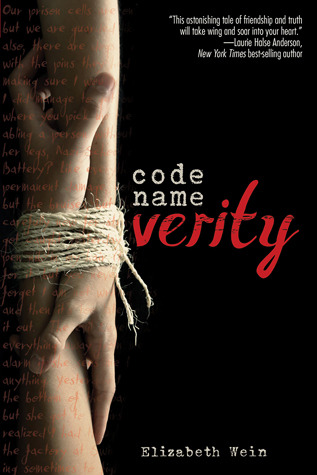
Code Name Verity by Elizabeth Wein

Verity, a British secret agent, has been captured in France by the Gestapo.  There she is questioned and forced to reveal her mission.  Verity begins to tell her story, starting with her friend Maddie, a girl who dreamed of flying airplanes, to her own beginnings as a secret agent, to how she ended up alone in France.

The second half made the first half good.  It certainly was very cool to see how everything suddenly came together and made sense.  However, it didn't fix some glaring issues for me.  The entire first section of the book I was mostly just confused.  I couldn't understand what the point was.  Why was she writing this?  She was giving zero helpful information that the Nazi could actually use.  Why was she allowed to write it?  Why on Earth would she be allowed to write it in a narrative form?  It would be a waste of time and resources.  It was difficult for me because the entire premise of the book didn't make sense to me: That Verity would be writing this narrative of how she ended up a prisoner.

The second part, from Maddie's point of view also didn't really make sense.  For a girl that was so concerned about doing things the regulation way, and feared getting other people captured and killed, she would really have kept a detailed narrative of her time, with names of the people that helped her and exactly how they carried out their plans?  I know, I know.  Literary license, and we needed them to write it all down, or else how would we know?  But...I couldn't get passed it.  All the trouble has been gone to to create a realistic sense of place, except for this one thing the whole book revolves around wouldn't have actually happened.

If you can get past that, it's certainly a good story and great to see how everything comes together perfectly.  It was certainly good storytelling and good writing.  I enjoyed reading it.  I don't want to say too much about it, because it really was great how it all came together.  I made me go back to Verity's section a few times to see what she had written and how it matched up with what Maddie was revealing.

This was one of the Printz honor books, and I can see why it was chosen.  But man, it sure did bug me the whole time that the set up was how Verity was writing her confession.  In novel form.

Thursday, February 14, 2013

Never Fall Down by Patricia McCormick

Arn is young when the Khmer Rouge comes to power in Cambodia.  Along with his family and all the residents of his city, he is forced out to the countryside, separated from everyone he knows, and sent to work in the rice fields.  All around him Arn watches as people begin to starve.  When the children are asked if anyone knows how to play an instrument, Arn says he can, even though he's never played anything before.  Perhaps this will be they way that he can survive.

I'd never read any fiction about Cambodia and the Khmer Rouge, and now within a year I've read two excellent ones.  Much like In the Shadow of the Banyan by Vaddey Ratner, Never Fall Down is a novel that is based on a true story.  Patricia McCormick worked closely with Arn Chorn-Pond to tell his story.  But just as Ratner felt, Chorn-Pond thought there were too many holes in his childhood memories to write a memoir.

Arn is not well off when the story begins, he and his brother beg for food on the street, but they used to be rich.  Arn has to make sure that no one ever finds this out, because rich people, academics, royals, government soldiers, all were systematically killed by the Khmer Rouge.

Thursday, February 7, 2013

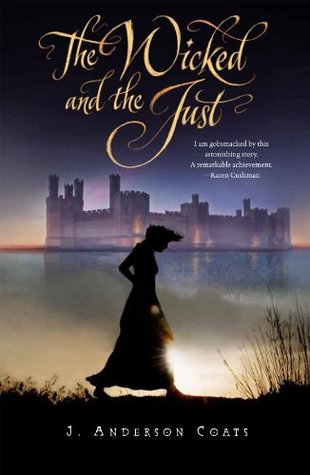
The Wicked and the Just by J. Anderson Coats

Cecily grew up at Edgeley Hall in England, but when her uncle comes back from the Crusades, her father decides, rather than acting as his brother's steward, he will move to Caernarvon in English occupied Wales where he can own his own land and house.  Cecily is less than happy about moving to barbaric Wales.  Gwenhwyfar's life was destroyed by the coming of the English.  Her people are starving around her, and she is forced to work in a house and on land she once owned.

This was heavy.  Seriously heavy.  This is a middle grade book, but I want to be clear that the violence and assault that happens is detailed.  Not in a sensationalized way, but certainly graphic.

This was another period of history I knew very little about.  In the later 1200s, Wales pretty much became a colony of England, under King Edward.  Stone cities were built that English colonists could live in, effective protected from the Welsh people by guarded stone walls.  Of course, there were rebellions, and the one The Wicked and Just details was the first one, which happened in 1294 and was led by Madog ap Llywelyn.

Wednesday, January 9, 2013

Waiting on Wednesday: Strands of Bronze and Gold by Jane Nickerson


"Waiting On Wednesday" is a weekly event hosted by Breaking the Spine to spotlight an upcoming release that we're excited about. This week I'm waiting on Strands of Bronze and Gold by Jane Nickerson.

The Bluebeard fairy tale retold. . . .

When seventeen-year-old Sophia Petheram’s beloved father dies, she receives an unexpected letter. An invitation—on fine ivory paper, in bold black handwriting—from the mysterious Monsieur Bernard de Cressac, her godfather. With no money and fewer options, Sophie accepts, leaving her humble childhood home for the astonishingly lavish Wyndriven Abbey, in the heart of Mississippi.

Sophie has always longed for a comfortable life, and she finds herself both attracted to and shocked by the charm and easy manners of her overgenerous guardian. But as she begins to piece together the mystery of his past, it’s as if, thread by thread, a silken net is tightening around her. And as she gathers stories and catches whispers of his former wives—all with hair as red as her own—in the forgotten corners of the abbey, Sophie knows she’s trapped in the passion and danger of de Cressac’s intoxicating world.

Glowing strands of romance, mystery, and suspense are woven into this breathtaking debut—a thrilling retelling of the “Bluebeard” fairy tale.
(Summary from Amazon)

I know, I know. I'm obsessed with retold fairy tales. But they're so good! Or at least this one sounds quite awesome. Lots of intrigue and suspense! Huzzah!

Strands of Bronze and Gold comes out Mar. 15.

Friday, October 19, 2012

The Sixty Eight Rooms by Marianne Malone

Ruth just wants to have her own space, her own experience that is unique for her. She wants to do something unusual that sets her apart, in other words she wants to be more like her best friend Jack. Jack is quirky and outgoing, his life seems like one adventure after another. Their positions seem to switch when they go to the Thorne Rooms at the Art Institute of Chicago, the miniature rooms that have scale items and represent historical rooms, and they find a magical key.

The key draws Ruth and when she touches it she shrinks! All of a sudden Ruth and Jack are exploring the miniature rooms (illegally over the weekend!), making contact with people from different countries and centuries, and trying to discover who has preceded them in the rooms. As they are trying to understand the rules that allow them into the Thorne Rooms, they are also dealing with the real world problems that are popping up: Jack and his mother might have to move and a famous photographer's lost work.

Snooze. The premise is fantastic. Have you seen the Thorne Rooms? They're amazing! Why wouldn't anyone want to explore them? They're beautiful and so realistic. Unfortunately that's all it seems to have going for it. A book cannot float on a great premise and a real setting which is vividly described. And unfortunately that's what it felt like because none of the other elements were strong enough to keep it going.

Tuesday, July 24, 2012

Kizzy Ann Stamps by Jeri Watts

Kizzy Ann Stamps in nervous about school starting.  For the first time, school will be integrated and Kizzy Ann will be going to what once was the all-white school. Fitting in would be hard enough anyway, but Kizzy Ann was in an accident that left a long scar on her face.  Luckily she has her loyal border collie, Shag, who always knows how to comfort her. 

The story is told through what start out as letters Kizzy Ann writes to her new teacher, and then turn into journal entries once she gets to school and her teacher gives her a journal.  Kizzy Ann is a smart, sharp girl who sees the injustices and unfairness around her, but doesn't know how things will ever get better.

This is a middle grade book that doesn't get too deep into issues of race and segregation.  There are no screaming white people outside of Kizzy Ann's school, although she does mention that a bunch of the white teachers quit rather than teach a black student.  Kizzy Ann and her Black classmates don't need government protection to attend school.  All the white kids do not get pulled out of the class by their parents.  It's clear there are race issues, but it never gets too violent or dark.

Kizzy Ann has a changing relationship with a white boy, Frank Charles, who is also the boy who gave her her scar, although it was an accident.  Frank Charles lives near Kizzy Ann and they are in the same class.  He loves Shag, and is always trying to play with her.  Kizzy Ann doesn't know what to make of Frank Charles, who seems nice enough, but his father is actively mean.  Mr. Feagans once had Kizzy Ann publicly whipped for talking back to Frank Charles.  Mr. Feagans, however, has a dramatic change of heart after seeing Kizzy Ann help his wife while having a seizure.  Then he goes from yelling terrible things at her to helping her and Shag compete in a sheep herding competition.  I found that very unlikely and unrealistic, but I understood why it was done.  This was not a book that delved too deeply into why people acted the way they did.  It was a book about how you should always try and good things can happen, even when it seems hard.

What was more realistic was the other white children in Kizzy Anna's classes growing more and more use to her and the other Black kids over time and by the end of the year, she was even sort of friends with a few of them.  That seemed real, the changing natures of the younger generations, and the determined holdouts of the older generations.

This is also a book for dog-lovers.  Oh how Kizzy Ann loves her dog, which never left her side when she was injured.  Shag, to Kizzy Ann, is the smartest, best dog there possibly could be, and she talks about Shag a lot.  Shag helps Kizzy Ann to move ahead when she gets stuck, and it's through training Shag that Kizzy Ann is able to make new friends and take steps for change.


Kizzy Ann Stamps comes out August 14, 2012.

Monday, July 23, 2012

In the Shadow of the Banyan by Vaddey Hatner

Raami is seven in 1975 when the Khmer Rouge forces everyone to leave the cities of Cambodia.  Raami, along with the hundreds of thousands forced from the cities, are put into work camps in peasant villages all over Cambodia.  With people dying all around her from starvation or from be suspected of being against the Organization, Raami struggles to survive and stay with what is left of her family.

This was pretty amazing.  It was hard to read, but beautifully done.  Vaddey Hatner chose to write a novel rather than a memoir because she was 5 years old in 1975.  She wanted to have the freedom to tell the story, but everything that happened to Raami happened to Vaddey.

My knowledge of the Khmer Rouge and what happened in Cambodia was very limited.  I knew about Pol Pot, and that millions of Cambodians died, and that was about it.  The problem with history in high school is that no one every gets past the 60s and the Vietnam War.  As we get further and further away from the 60s, we're missing out on learning about a growing chunk of history.  After I'd read the first chapter of In the Shadow of the Banyan I had to stop and go do a bit of background research so I would have a little foundation for understanding.

Saturday, July 14, 2012

Courtship & Curses by Marissa Doyle

 It's 1815, and Sophie should be excited about her coming out to London society, but illness has made her walk with a limp, and she knows the only match she'll make for herself is one that's after her money.  Finding a husband loses its importance when Sophie realizes someone is using magic to attack the members of the War Cabinet, including her father!  It's up to Sophie to figure out who's behind it, all the while trying to keep her own magic a secret.

A delightful romp!  I thoroughly enjoyed this.  It was light and quick and pleasure to read.  Sophie and her friend Parthenope (name of a siren in Greek mythology, I knew it had to come from somewhere) were absolutely delightful, especially Parthenope who acted completely out of character for a English lady in 1815, what with her mouthing off and punching a rakish young man in the nose (he deserved it).  Parthenope was completely over the top, yet a very sweet, caring character and I loved reading her.
Related Posts Plugin for WordPress, Blogger...