Authors sign protest letter against baseline tests. From The Bookseller.
The trailer for Me And Earl And The Dying Girl will lift you up, so it can crush you. From The AV Club.
Illinois Law Lets Schools Request Students’ Social Media Passwords. From SLJ.
'Call Me Tree': A Children's Book With No Gender Specific Pronouns. From The Huffington Post.
Terry Pratchett's final Discworld novel due out in September. From The Guardian.
Marissa Moss's Amelia Graduates Middle School—and Turns 20. From PW.
How Asperger’s powers my writing. From The Guardian.
Authors praise rise in LGBT-themed kids' books. From The Bay Area Reporter.
Despite Citywide Cuts, West Philadelphia Alliance for Children Opens 18th School Library. From SLJ.
Missouri’s Governor Will Release Library Funding That Has Been Withheld Since Last June. From Library Journal.
Francesca Lia Block says Weetzie Bat is not a manic pixie dream girl: “I don’t love what I’ve seen of that.” From Salon.
Inside The Mind Of The World's Naughtiest Children's Book Illustrator. From The Huffington Post.
BBC chooses best children's books of all time - do you agree? From The Guardian.
Book author Joan Walsh Anglund says of Angelou stamp: ‘That’s my quote.’ From The Washington Post.
Dark Horse Comics Picks Up Magical Girl Zodiac Starforce. From SLJ.
Saturday, April 25, 2015

Thursday, April 23, 2015
Bluffton: My Summer with Buster by Matt Phelan
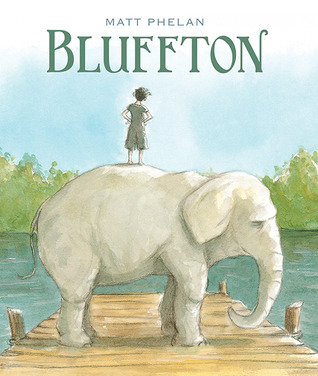
Henry is a fictional character, but all the vaudeville people mentioned in the book are real, and they really did summer at Bluffton where Joe Keaton, Buster's father, founded The Actor's Colony. Buster, of course, is Buster Keaton, famous comedian and film star. Before he became that famous film star, we learn, he was part of a family act where he was "the human mop." He got throw around, took lots of falls, and got right back up again.
Henry is jealous of Buster. Henry thinks his life is boring. Here he is in this nothing little town, where nothing every happens. His father owns a store. He helps his father in his store. He goes to school. That's his life. But Buster! Buster gets to travel the world! He can do all sorts of tricks and falls. He can juggle. He meets all kind of interesting people. He's personable and friendly. Henry wants to be like him.
Buster, we the reader can see, does not think he's quite so lucky. He wants to spend his summer, the only time he doesn't have to perform, playing baseball. He doesn't want to teach Henry falls and tricks. He doesn't want to do them when he doesn't have to. We can tell Buster wishes he'd had more schooling. Perhaps more of a "regular" life. That maybe he doesn't want to be in vaudeville forever, but Henry can't see that.
There's a lovely moment in the book where Henry talks to his father about not wanting to be a store keeper. His father tells him he never expected him to be. He wants Henry to do whatever will make him happy.
The art is done in lovely pale water color. It invokes a feeling of "another time." There are many wordless panels where everything we need is in a look or gesture. A beautiful book. Might take some pushing to get kids to read it. It might not be one they'll just pick up. Sell it by talking about the elaborate pranks Henry and Buster pull on the school principal.
Tuesday, April 21, 2015
How to Fake a Moon Landing: Exposing the Myths of Science Denial by Darryl Cunningham

I found this to be a very informative book, but it's also a book that's preaching to the choir. You're not going to pick up this book if you're a person who thinks climate change doesn't exist or that there's no such thing as evolution. This isn't going to be the book that manages to convince naysayers otherwise, because the naysayers aren't going to pick up a book on exposing the myths of science denial, even if it's in a friendly graphic novel format.
But if you're a person who's interested in where these myths come from, and how they can scientifically be refuted (so you can impress your friends and be prepared for your next cocktail party when someone says, "So what do you think about fracking?") this is the book for you.
What I liked about it was that it stressed critical thinking and the scientific method. Cunningham was very clear that just because we find something to be true now using the scientific method, doesn't mean that that will always be the case. Some new piece of information or research might come along that changes things. Something new might be discovered. But we must think critically and base our understanding on facts that come about through careful experimentation and observation. We can't disregard pieces of information because they don't fit with what we personally think, or what we'd like to be true.
Cunningham provided evidence for each issue he was looking at, as well as explaining how the myth originated, and how scientific data and facts can prove the myth inaccurate.
The writing is clear and straightforward, although I found some concepts easier to understand than others. I still find the concept of fracking confusing. Also, frack will never not make me think of Battlestar Galactica (the one with the moral dilemmas, not the one with the laser beams).
The book is arranged in strips, with three rows on each page with two panels per row with little variation. The art is carrtoonish, and is mixed with real photographs and detailed portraits of individuals mentioned. It made for an interesting mix.
While younger middle school students might have difficult, I think this would be appropriate for 8th grade and up.
Sunday, April 19, 2015
News
The Case For Libraries. From PW.
How I made friends with a famous author: Jeanne Birdsall. From The Guardian.
Those Tired Summer Reading Lists. Here’s What to Do. From SLJ.
The Ecstasist: A Conversation with the Novelist Jonathan Lethem. From boingboing.
Pour Some Sugar on Me (But Don’t Tell My Mom): Why We Shouldn’t Sugarcoat YA. From BookRiot.
Fun National Poetry Month Apps and Resources for Teens. From SLJ.
Enough With the Holocaust Books for Children! From Tablet Magazine.
17 Stories That Will Make You Want To Hug Your Librarian. From BuzzFeed.
And Here's The Entirety Of 'Alice In Wonderland' In Emoji. From The Huffington Post.
Where’s the Quote from: Classic or YA Lit? From Epic Reads.
Being A Feminist In the Kids’ Section. From BookRiot.
Goodbye 1700: DC’s New York offices close for good today. From The Beat.
Using Comics to Teach English Language Learners. From SLJ.
25 Beautiful Vintage Beverly Cleary Book Covers. From Flavorwire.
Shailene Woodley’s Speech Brought John Green To Tears At The MTV Movie Awards. From BuzzFeed.
Her Stinging Critiques Propel Young Adult Best Sellers. From The New York Times.
Teaching With Graphic Novels. From SLJ.
Thursday, February 26, 2015
News
The 10 Most Anticipated Book Adaptations of 2015. From PW.
Children’s books are never just for children. From The Guardian.
Universal Options ‘The Princess In Black'. From Deadline.
African-American Experience Children’s Literary Reference Guide. From SLJ.
Laurie Halse Anderson Thinks Adults Should Be Reading More YA. From BuzzFeed.
Children's Choice Book Award Finalists Announced. From PW.
CCBC Stats Show Children’s Books Shifting Toward Diversity. From PW.
Newly Discovered Dr. Seuss Book to Publish in July. From SLJ.
'Not my words': John Green's wrongly attributed line and other misquotations. From The Guardian.
John Green's Southern Exposure. From PW.
Kansas May Criminalize Educators for Distributing “Harmful Material." From SLJ.
The Hidden Story of Harley Quinn and How She Became the Superhero World’s Most Successful Woman. From Vulture.
Children’s books are never just for children. From The Guardian.
Universal Options ‘The Princess In Black'. From Deadline.
African-American Experience Children’s Literary Reference Guide. From SLJ.
Laurie Halse Anderson Thinks Adults Should Be Reading More YA. From BuzzFeed.
Children's Choice Book Award Finalists Announced. From PW.
Rachel Martin talks with National Book Award-winning author Thanhha Lai about her children's book, Listen, Slowly. From NPR.
Patrick Ness reveals the cover of his new book! From The Guardian.
Patrick Ness reveals the cover of his new book! From The Guardian.
CCBC Stats Show Children’s Books Shifting Toward Diversity. From PW.
Newly Discovered Dr. Seuss Book to Publish in July. From SLJ.
'Not my words': John Green's wrongly attributed line and other misquotations. From The Guardian.
John Green's Southern Exposure. From PW.
Kansas May Criminalize Educators for Distributing “Harmful Material." From SLJ.
The Hidden Story of Harley Quinn and How She Became the Superhero World’s Most Successful Woman. From Vulture.
Tuesday, February 24, 2015
Jane, the Fox & Me by Fanny Britt, illustrated by Isabelle Arsenault

This was lovely. A heartfelt story about bullying, the feeling of isolation, and the impact a single person can make by reaching out to another.
Helene takes things especially hard because the girls who are now tormenting her were once her friends. Helene doesn't really know what happened, but now she has no one. No one will talk to her. She is a social outcast. Helene works her way through Jane Eyre, finding a companion in isolation and comfort that things can work out OK, even for someone who is friendless. Helene begins to despair when things take a bad turn for Jane, and she has to go on a retreat with her whole class.
It's on this retreat that Helene, feeling more alone than ever, sees the fox. The fox is beautiful and approaches her. But even this magical moment is ruined and makes her feel like a freak.
I was confused throughout the book by how Helene was draw. All her ex-friends are calling her fat. She's sure her mother is ashamed of her. But she didn't look overweight at all. It all becomes clear toward the end when Helene goes for her yearly physical and her doctor informs her she's right on track. Helene insists she's fat. The doctor informs her she isn't anything of the kind. The kids at school calling her fat got into her head until Helene truly believed that she was. And the kids calling her fat were just being cruel. It was based on nothing.
The illustrations were for the most part in gray and black, reflecting Helene's depression and feelings of isolation. The only color was when we saw Jane Eyre. Jane's life had a little color in it, although Jane herself was still all black and white. For Helene, everything is gray until the fox appears. The fox is bright with color. A fleeting brightness in Helene's life. But then it's gone and everything is black again.
As Helene makes friends with Geraldine, color begins to come into Helene's world. Not right away. But after making a friend and realizing she isn't actually overweight, we begin to see a few spots of color. On sneakers and tee shirts, in the trees, and it ends with Helene walking into a world of color.
Tuesday, February 17, 2015
News
John Green to Wi10 Booksellers: Life Would 'Suck Without You'. From PW.
"I Am Malala" Wins Grammy For Best Children's Album. From Forbes.
Pennsylvania: Budget Cuts Take Toll On School Librarians In Philadelphia. From Library Journal.
My inspiration: Jennifer Niven on Virginia Woolf. From The Guardian.
Someone Is Writing The Ultimate Generic Dystopian YA Novel On Twitter. From io9.
Which YA character would be your BFF? From BuzzFeed.
2015 Battle of the Kids’ Books Battle Plans and Brackets Unveiled. From SLJ.
Interviews with some of the Battle of the Kid's Book contenders: Candace Fleming, Cece Bell, Gregory Maguire, Jacqueline Woodson. From SLJ.
Subscribe to:
Posts (Atom)
