What librarians make by Joyce Valenza in response to Dr. Marc Bernstein, Superintendent for the Valley Stream (NY) Central High School District who suggested "eliminating the antiquated requirement that all high schools have at least one full-time librarian and a minimum number of books."
Medallion Press launches Ya-Ya Imprint. YA books written by young adults.
10 best illustrated children's books as chosen by The Observer's Kate Kalleway.
Check out the most beautiful public libraries in the US.
Tuesday, November 30, 2010

Monday, November 29, 2010
Incarceron by Catherine Fisher

Incarceron was created years ago to take the undesirables out of the world. These prisoners would be part of a grand experiment; they would live in a utopia that was monitored by the Sapienti and maintained by Incarceron. Perfect right? The poor, the protesters, and the criminals, would all be gone and yet could still be rehabilitated in an enclosed space that they couldn't get out of. But no one took into consideration that Incarceron would slowly become sentient, and she would no longer want to play by someone else's rules.
Finn is a seventeen year old prisoner inside of Incarceron, he plays his role as an underling in a cutthroat community and survives. Finn is different, he cannot remember his childhood and has strange visions and memories that come to him during fits. Sapient Gildas calls him a Star Seer and believes him to be the second coming of a mythical man that got Out. His Oathbrother Keiro believes that Finn is a tool to be used to get what he wants. The dog-slave Attia sees Finn as a hero who she owes her life to. As they travel through Incarceron, Finn questions who to believe as he puts all of their lives into the hands of a girl he talks to through a key.
Claudia has grown up learning how to maintain a house in-Era and play the political game better than most men twice her age. She is on the verge of becoming queen and all she wants is a way to get out. As her wedding day to an odious royal brat draws nearer, Claudia is drawn in to the mystery of Incarceron. She discovers Finn through a key she steals from her father's office. Soon she is playing a game that is over her head and all she can do is hold on to the belief that Finn is the one to save not only herself but the kingdom as well. Claudia believes Finn is meant to be king.
Friday, November 26, 2010
The Mockingbirds by Daisy Whitney
 Alex got drunk for the first time at a concert. And that night she was date raped. Alex knows the administration at her prestigious boarding school has a history of looking away from any issues that might make their students seem less than perfect. So Alex goes to the Mockingbirds, a secret student organization that tries crimes and doles out punishment. As Alex slowly remembers more and more about that night, she wonders if she's doing the right thing.
I had mixed feeling about this book. On the one hand, I think date rape is an important topic to talk about. Rape does not have to be done by someone the victim doesn't know; it doesn't even have to be especially violent. The lack of consent is what makes it rape. Alex struggles with this, wondering if it's her fault. She got herself drunk, she was talking to Carter. Is it his fault? Or is it her fault? Does she have a right to be upset about it?
Tuesday, November 23, 2010
New Orleans 2011!

Here we come Louisiana! It's official, the wandering librarians (plus one) are headed to New Orleans in June. Once again we're headed to the annual ALA conference, this time in steamy New Orleans. See you there, just 304,504 minutes until we touchdown. Awesome.
Alberic the Wise and Other Tales by Norton Juster, illustrated by Domenico Gnoli
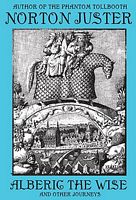 A compilation of three short fairy tales: "Alberic the Wise", about a man named Alberic who spends his life searching for wisdom and trying out many vocations along the way, only to find as an old man he is perceived as wise because of his experiences; "She Cries No More", about a young boy named Claude, who doesn't care about anything until he steps inside a painting to help a beautiful lady; "Two Kings", where a king who lives in poverty and a king who lives in great abundance set out to find out if there's another kingdom better off or worse off than they are.
While this was a very short book (only 88 pages) and it wasn't very complex, and it has pictures and all, this isn't really a children's book. In the same that fairy tales weren't really meant for children, it just ended up that way. They are stories that teach a lesson, and they were nice stories, and I enjoyed them very much, but I also don't really see myself recommending this as a fun read for very many children. It is the kind of book a parent gets to read aloud to their kid and then talk about it.
For example, in "Two King," Good King RNP's kingdom is in ruins. The weather is always bad, no one has any money, and no one even knows who the king is. He's completely miserable, but his only adviser assures him that it's probably worse everywhere else. Meanwhile, King Magnus the Abundant's kingdom is beautiful, happy, and plentiful. However, King Magnus wonders if somewhere out there there's some who has more than he does. Both kings set out to see for themselves. King Magnus' people love him so much they don't want him to be sad when he gets somewhere where people don't greet him, so the entire kingdom packs up and secretly travels to King RNP's kingdom, fixes everything up, and then lines the street to greet him. King Magnus is happy, until he sees how new and beautiful everything is and thinks that someone does have things better than he does. King RNP arrives and King Magnus' deserted kingdom, where a storm as destroyed much of it. He looks around at the destroyed, abandon town, and thinks that some does have things worse than he does. King RNP goes home happy, and King Magnus goes home sad.
I was most interested in "Alberic the Wise," where Alberic goes from vocation to vocation, but not really being good at anything and then moves on. This reminded me very much of Lloyd Alexander's Tarran Wanderer. I bet there's some Old Norse or Old English story that both were based on. Maybe I'll email my Literature and the Fantastic teacher and ask her.
So anyway, I liked it a lot, I love Norton Juster, good stories, not exactly a kid's book though.
Monday, November 22, 2010
FABLES: Legends in Exile by Willingham, Medina, Leialoha, and Hamilton
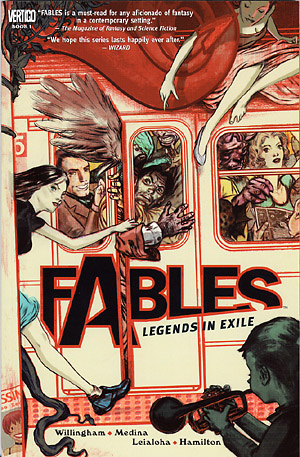
Fairytales live among us, but they're not what you'd expect. They've been driven out of their homes by a mysterious power only known as the Adversary. Those who can fit in with the 'mundies' live in Manhattan, while those that are more difficult to explain away live up on the upper eastside on The Farm. They have their own government, identities, and issues. They are not the Disney-fied characters that you grew up with.
I'm really enjoying this series so far. I've wanted to read it for a while, and a friend loaned me the first two volumes. I'm so happy she did. It seems that each volume (so far) deals with mysteries with the overarching theme of the Fables getting back to their lands and overthrowing the Adversary. There's all these little plot twists and turns to keep things interesting, but what really got me was the character development. They fairytale characters are essentially immortal and so they have twisted personal issues that have lasted for centuries; e.g. when Beauty doubts her love for the Beast he gets horns. But they're not all silly, most of the fairytale characters are dealing with doubts about self-worth, money, identity, and overcoming the stereotypes that they were written into. These are characters with depth and emotions that are tapped into beautifully through the illustrations of Mark Buckingham and Steve Leialoha. This is what was one of the main contributors of what hooked me; how well the drawings and the text play into each other and really develop it into something really special.
ZENtertainment kind of epitomizes the feeling I got from reading this, "FABLES not only lives up to - but actually exceeds - all of the hype." Volumes 1-13 are already out and the 14 comes out in December.
The Sweetness of Salt by Cecilia Galante
 Julia has just graduated from high school. She was valediction. She's getting a free ride to college where she will be pre-law. She will be spending her summer at a law related internship. Everything is perfect, just as Julia's life has always been. Then Julia's sister, Sophie, comes home. Sophie never got along with their parents. She's still angry about the time they spent in Milford, before Julia was born. Julia thinks she knows everything that happens, but Sophie says there's something that their parents haven’t told her. Julia ends up spending the summer with Sophie, helping Sophie getting ready to open her own bakery. Julia wants to learn the whole truth, but even Sophie has a hard time explaining.
This book and I got in a fight on page 105. This is Sophie talking to Julia about her bakery: "Plus, I want to have a wall for all different kinds of specials. Maybe a certain bread - like Irish soda bread for St. Patrick's Day, fruitcake for Christmas, or challah bread for Passover - whatever." Challah is eaten on Shabbat. Shabbat starts every Friday night and ends Saturday night. Every single week. On Passover, Jews don't eat any food that has leaven, so Passover is actually one of the few times when challah would NOT be eaten. Why, when writers are writing about a culture that is not their own, don't they double check things? Why don't the editors? I'm sure this happens all the time and I don't pick up on it because I don't know. But when I can pick up on it, it annoys me to no end. So of course, I immediately went to my computer to send an email to Bloomsbury. There's usually a "please e-mail your comments" address on the back of ARCs. Which there was. And the contact person was Deb Shapiro. You know how cranky it made me that I had to email someone name Deb Shapiro and tell her that Jews don't eat challah on Passover? I know, I know, I'm sure Deb didn't have anything to do with the editing of the book. They have not emailed me back, by the way.
Subscribe to:
Posts (Atom)
